From Architect to Furniture Maker: A Conversation with Yoav Liberman
Table of Contents
- Background - From Architect to Furniture Maker
- Process of a Renaissance Man
- When you begin a new piece, what usually comes first: a functional problem, a visual idea, or something else?
- Six Pack -- Reclaimed Heart pine, wenge, aluminum. 18 x 5.5 x 10 inchesWhat materials do you enjoy working with most, and why?
- What separates a well-designed piece of furniture from one that's simply attractive?
- Are there any design mistakes or construction shortcuts you see too often in modern furniture?
- The Tools He Depends On
- What's your current workflow from concept to finished piece? Has technology changed that process over the years?
- Do you rely more on hand tools, machinery, or digital tools? How do you decide which approach is right for a project?
- Are there any tools in your shop that you couldn't imagine working without?
- You've developed several woodworking tools and accessories over the years. What inspires your inventions, and how do you approach solving problems?
- Magnetic Straightedge
- Advice for Future Furniture Designers
Background - From Architect to Furniture Maker
You were originally trained as an architect. What led you to pursue furniture design and woodworking instead?
I'm incredibly grateful for my architectural training. It gave me what I like to call an "eagle's-eye view" of design. Architecture isn't just about buildings—it brings together human needs, ergonomics, engineering, aesthetics, color theory, and psychology. It's a remarkable foundation for anyone who wants to create things.
Classically, architects were master draftspersons, sketchers, and model builders—skills I loved from childhood. But I eventually realized those hands-on elements had largely disappeared from modern architectural practice. Today, most work happens digitally in CAD, and much of an architect's day is spent in front of a computer.
For me, working directly with materials has always been essential. I wanted to be a true craftsman—someone who could both design the work and build it.
Architecture naturally connects to several traditional crafts, including masonry, metalworking, and woodworking. Wood simply spoke to me. It literally grows on trees, it's renewable, full of character, and rich in texture and history. Woodworking allowed me to apply everything I learned about design and engineering while creating something tangible with my own hands.
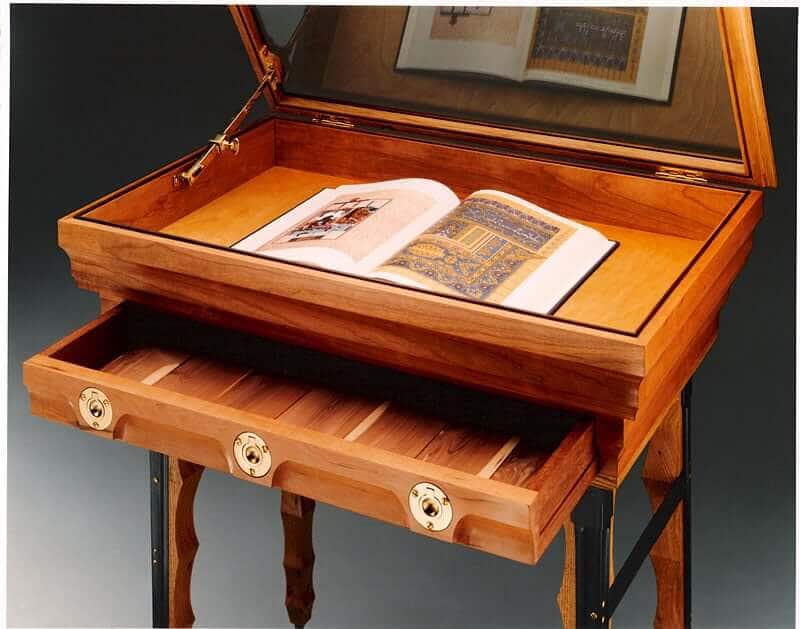
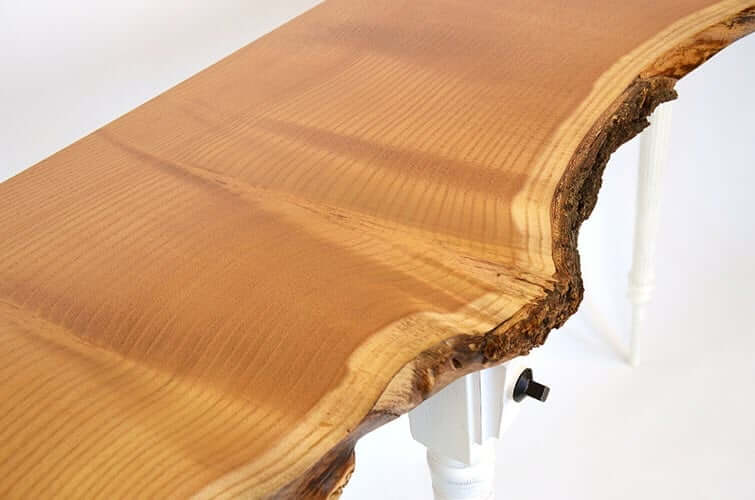 Mulberry Trio console table -- Mulberry, oak, steel, milk-paint. 52L x 36H x 17.5W inches
Do you find yourself thinking like an architect when designing furniture—considering proportion, structure, or how people interact with a space?
Absolutely. My process is really a constant conversation between the architect and the furniture maker.
Architecture sometimes has the shortcoming of becoming detached from the material itself. An architect may understand what can be built without fully appreciating how wood behaves—how it moves, what the grain can support, and where its limitations lie.
Because I work directly with the material, my architectural thinking is grounded in the realities of the shop. Every project balances practical concerns with aesthetics. I ask myself: Is it functional? Is it beautiful? Will it feel intuitive to use? Can it push the design just a little further without compromising strength?
The sweet spot is finding a design that's structurally sound, enjoyable to use, and still has something fresh to say.
Process of a Renaissance Man
When you begin a new piece, what usually comes first: a functional problem, a visual idea, or something else?
My answer has evolved over the years.
Early in my career I built mostly studio furniture, so projects usually began with my own curiosity. I'd explore a design idea, reinterpret a traditional furniture form, or experiment with reclaimed wood and let the material guide the final piece.
I've always admired 19th-century campaign furniture—beautifully engineered pieces that could be disassembled, transported, and reassembled with ingenious hardware. Reimagining that tradition with modern techniques was a major source of inspiration. At the same time, I became passionate about reclaiming wood from demolished buildings and discarded furniture, allowing each board's history and character to influence the design.
Today, much of my work is commissioned. The client's needs become the starting point—space, budget, materials, and function. From there, I develop sketches, present several concepts, and together we choose the direction that best fits both their needs and my design philosophy.
It's a rewarding shift from designing solely for myself to collaborating with someone who will ultimately live with the finished piece.
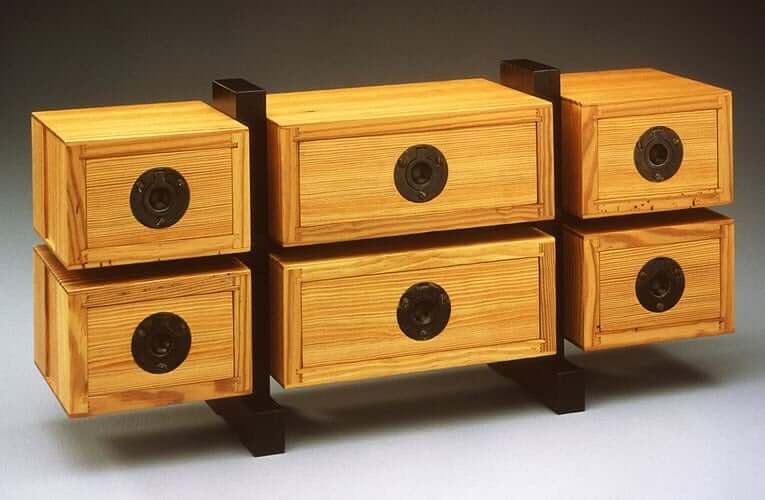
Six Pack -- Reclaimed Heart pine, wenge, aluminum. 18 x 5.5 x 10 inches
What materials do you enjoy working with most, and why?
Natural wood is my primary medium, and reclaimed wood sits at the top of the list. I love working with material that has already lived one life. A beam that grew in an old-growth forest, spent two hundred years supporting a building, and is now becoming furniture carries an incredible sense of history.
There's also an ethical side to it. I'll often rescue solid cherry furniture from estate sales or dumpsters. Even if it isn't centuries old, it's still beautiful wood. Watching quality lumber end up in a landfill simply doesn't sit well with me, so giving it a second life feels both creative and responsible.
Among my favorite species are Claro walnut, heart pine, ash, white oak, Sapele, and genuine Honduras mahogany. For carving, nothing compares to butternut.
I also appreciate tropical hardwoods like Wenge, Rosewood, and Ipe, though they're extremely demanding on hand tools. Since I rely heavily on traditional chisels, gouges, and hand planes, I generally prefer woods that work with those tools rather than against them.
To complement the wood, I often incorporate brass and copper accents, which add both visual warmth and structural interest.
What separates a well-designed piece of furniture from one that's simply attractive?
An attractive piece of furniture catches your eye, but a well-designed piece successfully balances beauty, structure, durability, and everyday usability.
Good design begins with longevity. The engineering has to be sound, the joinery has to last, and the piece needs to withstand real life. You have to anticipate how people will use it, clean it, and occasionally abuse it. At the same time, strength alone isn't enough. Simply making everything thicker creates clunky furniture. The goal is achieving maximum elegance without sacrificing stability.
One example is a cutting board I designed that has sold in the hundreds. I wanted a simple board with a rustic hemp hanging rope. The obvious solution would have been to drill a hole and thread the rope through it—but that leaves the rope underneath the board, making it rock on the countertop.
Instead, I carved two shallow grooves leading to the hole so the rope nests flush with the bottom. The board sits perfectly flat while in use, and when it's hanging on the wall, the rope becomes an intentional design feature rather than an afterthought. That's the difference between something that's merely attractive and something that's truly designed.
Great furniture also includes an element of originality. Whether you're working in Georgian, Arts & Crafts, Art Deco, or Modern styles, the piece should carry something uniquely your own. Sometimes that's as subtle as an inlay pattern or a custom molding profile.
Ultimately, beauty alone isn't enough. Good design combines aesthetics with structural integrity, longevity, and thoughtful solutions to real-world problems.
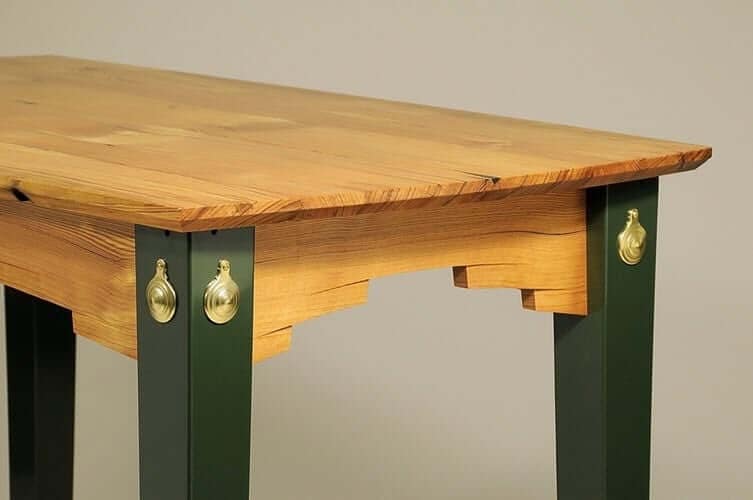 Merritt Desk. Found steel legs, reclaimed Heart pine, reclaimed brass. 44 x 32 x 27.5 inches.
Are there any design mistakes or construction shortcuts you see too often in modern furniture?
I tend to look at this from two perspectives: mass-produced furniture and contemporary custom furniture.
With mass-produced furniture, the biggest issue is intentional. Much of it is built with planned obsolescence in mind.
For example, we have a tall Shaker-style cabinet near the door that's only three years old and already falling apart. It's made from MDF with inexpensive cam fasteners, and the joints have begun to fail. That's not an accident—it's a product designed to meet a price point rather than last for generations.
With custom furniture, the issue is different. Most makers genuinely want to build quality work, but many haven't studied traditional furniture design deeply enough.
I often see historical details simplified until they lose their character. Crisp moldings become soft and indistinct. Elegant proportions become heavy or awkward. You also see it in architectural millwork, where the relationship between moldings, uprights, and base elements simply feels off.
Good design isn't just about copying a style. It's about understanding why those proportions worked in the first place, then using them intentionally.
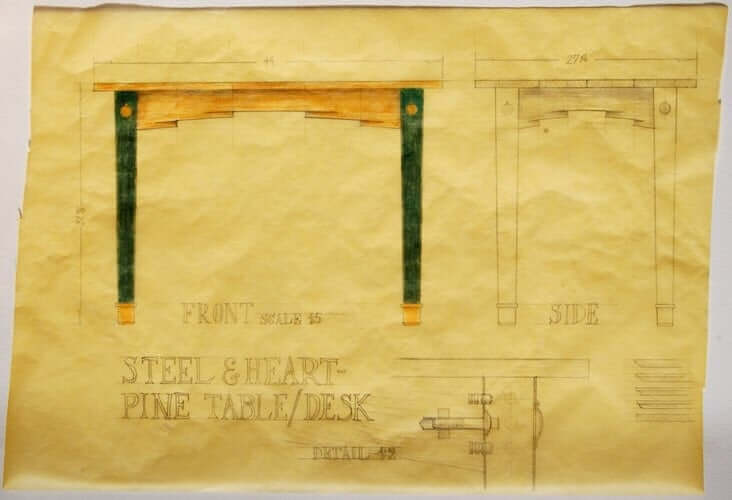 Merritt Desk sketch
The Tools He Depends On
What's your current workflow from concept to finished piece? Has technology changed that process over the years?
Teaching woodworking has had a tremendous influence on my design process. Explaining techniques to students forces you to think carefully about efficiency, clarity, and problem-solving.
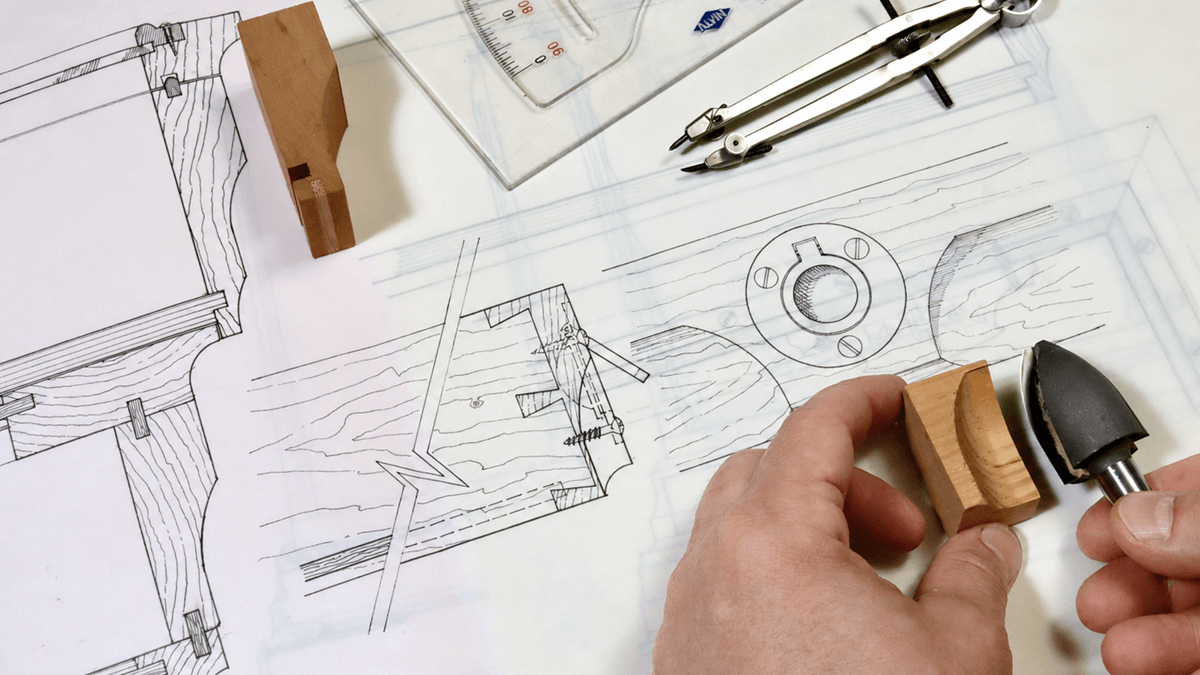
Every project still begins with a pencil and paper. I fill sketchbooks with freehand ideas because sketching offers complete freedom. You're not constrained by a computer—you can explore forms quickly, redraw them naturally, and refine ideas layer by layer.
Once a client approves a concept, I move to more detailed drawings using traditional drafting tools. I don't solve every engineering question immediately; some details are best worked out while I'm building the piece. For example, I may finalize drawer dimensions only after the carcass is assembled or develop a custom molding profile while referencing my router bit catalogs.
Technology has certainly changed my workflow, particularly for teaching and writing. When preparing articles, I often build 3D digital models because they make it easy to generate exploded views or change perspectives for readers.
Even then, I rarely leave the drawings purely digital. I'll often print them, place tracing paper over the top, and ink them by hand so the final illustrations retain the warmth of a hand drawing instead of looking like sterile computer renderings.
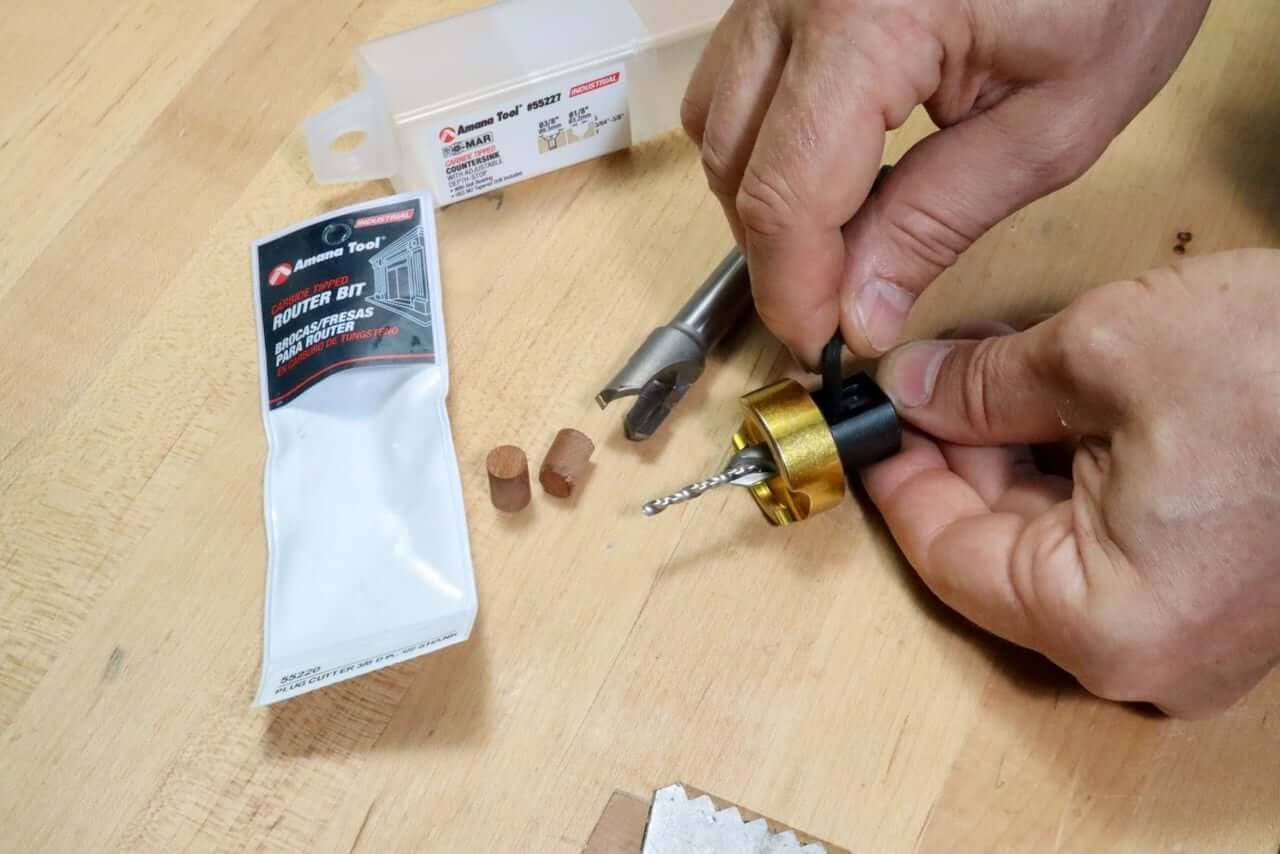 One of the tools Yoav depends on is his Amana Tool AMS-625 2-Pc Carbide Tipped Countersink with Adjustable Depth Stop and No-Thrust, No Marring Ball Bearing, set with plug cutter.
Do you rely more on hand tools, machinery, or digital tools? How do you decide which approach is right for a project?
I rely on both machinery and hand tools, choosing whichever is best suited to the task.
Machines handle the heavy work—milling rough lumber, dimensioning stock, cutting joinery, and producing moldings efficiently. Hand tools take over when precision matters most. They're indispensable for fine-tuning joinery, fitting parts perfectly, and carving organic shapes.
Often it's simply a question of efficiency. If I only need a couple of specialized joints, it makes more sense to grab a drill press, remove most of the waste with a Forstner bit, and finish the joint with a sharp chisel than spend an hour building a dedicated machine jig.
Today's CNC machines and robotic routers are capable of extraordinary work that once required master craftsmen. I admire what modern technology can accomplish.
But the reason I became a furniture maker wasn't to watch a machine do the work—it was to experience the material with my own hands. Using hand tools creates a connection with the craft that I never want to lose.
Are there any tools in your shop that you couldn't imagine working without?
My shop relies on a core group of machine workhorses and a deep lineup of traditional hand tools.
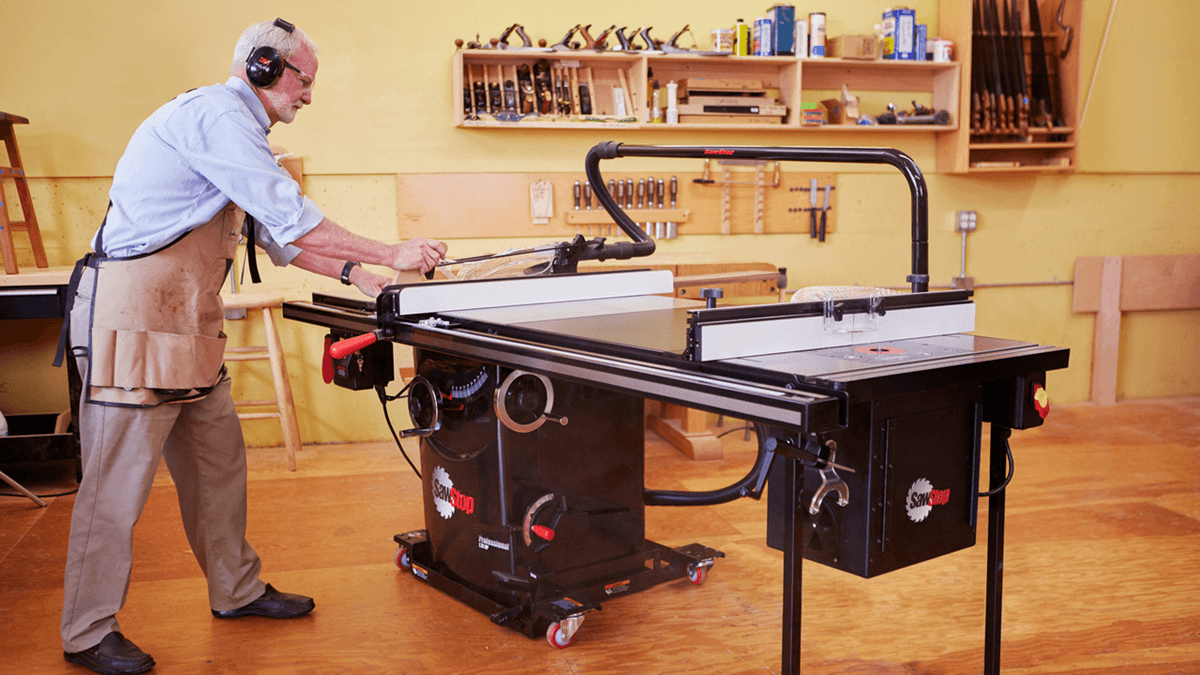
On the machinery side, I couldn't imagine working without my table saw for dimensioning stock and cutting joinery, my bandsaw for resawing hardwoods and cutting curves, or my jointer and thickness planer for preparing rough lumber.
My router table is equally indispensable. It allows me to quickly produce moldings and decorative profiles. In fact, I'm currently developing a multi-step routing sequence using an assortment of Amana Tool bits. By combining standard profiles into a unique composite shape, you can create sophisticated custom moldings without commissioning custom-ground cutters.
On the hand-tool side, I rely constantly on a good set of chisels and carving gouges, Japanese pull saws, and traditional joinery planes.
I also couldn't work without quality drill press accessories. A precision carbide-tipped countersink and matching plug cutters allow me to hide fasteners cleanly so the joinery—and the wood grain—remain the focus.
You've developed several woodworking tools and accessories over the years. What inspires your inventions, and how do you approach solving problems?
My mind is constantly working, even during my commute into the city where I teach. That's often when I find myself thinking about shop problems or asking, "How could this tool work better?"
Most of the time, I'm not trying to reinvent the wheel. I'm looking for a better, more efficient way to accomplish something woodworkers already do. Many of my ideas come from combining products from completely different fields in ways they weren't originally intended.
Over the years I've filled sketchbooks with ideas for tools and hardware. A few caught the attention of manufacturers, and two eventually made it into production. One was a compact drafting tool that transformed into a T-square, straightedge, and drafting triangle, which Lee Valley licensed. Another was a hand-held handle for hollow mortising chisels, which Rockler still sells today.
Not every idea succeeds. I once designed a stepped wooden dowel intended to mechanically lock joints together, only to discover a century-old patent that prevented it from moving forward. A few months later, Miller Dowels introduced a similar concept. Sometimes innovation simply happens in parallel.
Many of my inventions come directly from teaching. For example, I wanted a safer, easier way for students to hand-bore large holes for stool legs, so I combined a machinist's tap handle, an SDS-Plus arbor, and a drill chuck into a rugged manual boring tool. It solved a real problem in the shop, and that's exactly the kind of innovation I enjoy most.
Ultimately, I don't invent to make money. I invent to solve problems. Whether an idea becomes a commercial product or remains something I share freely through my writing and teaching, the goal is always the same: help people enjoy making things.
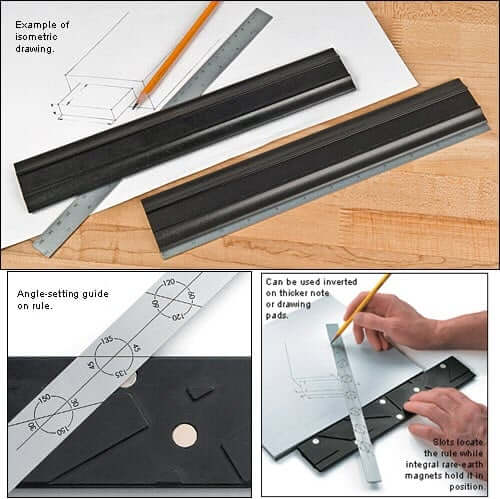 Magnetic Straightedge
Magnetic StraightedgeAdvice for Future Furniture Designers
What advice would you give to woodworkers who want to move beyond simply building projects and start designing their own furniture?
The most important thing you can do is free both your hand and your imagination.
Many beginners stare at a blank page feeling they have to create a perfect drawing immediately. Instead, start with loose sketches. Explore ideas without committing to them, then gradually refine the ones that show promise.
I also encourage every aspiring designer to learn technical sketching. I'm not talking about fine art—I'm talking about learning to think in three dimensions. Study perspective, elevation, and isometric drawing. Once you can comfortably sketch what's in your mind, designing becomes far less intimidating.
Just as importantly, immerse yourself in the history of furniture and architecture. Read books, visit museums, watch documentaries, and study the work of great designers. Learn why certain proportions work and how different styles evolved—but don't mistake popularity for good design. Develop your own critical eye.
For me, Art Deco has always been a tremendous source of inspiration. I admire its balance of beauty and practicality, and its belief that design should elevate the human spirit.
Ultimately, the journey from builder to designer comes from combining technical skill with curiosity. Study the masters, understand traditional proportions, and don't be afraid to create something that's uniquely your own. Every great furniture maker began by asking, "What if I tried it this way?"
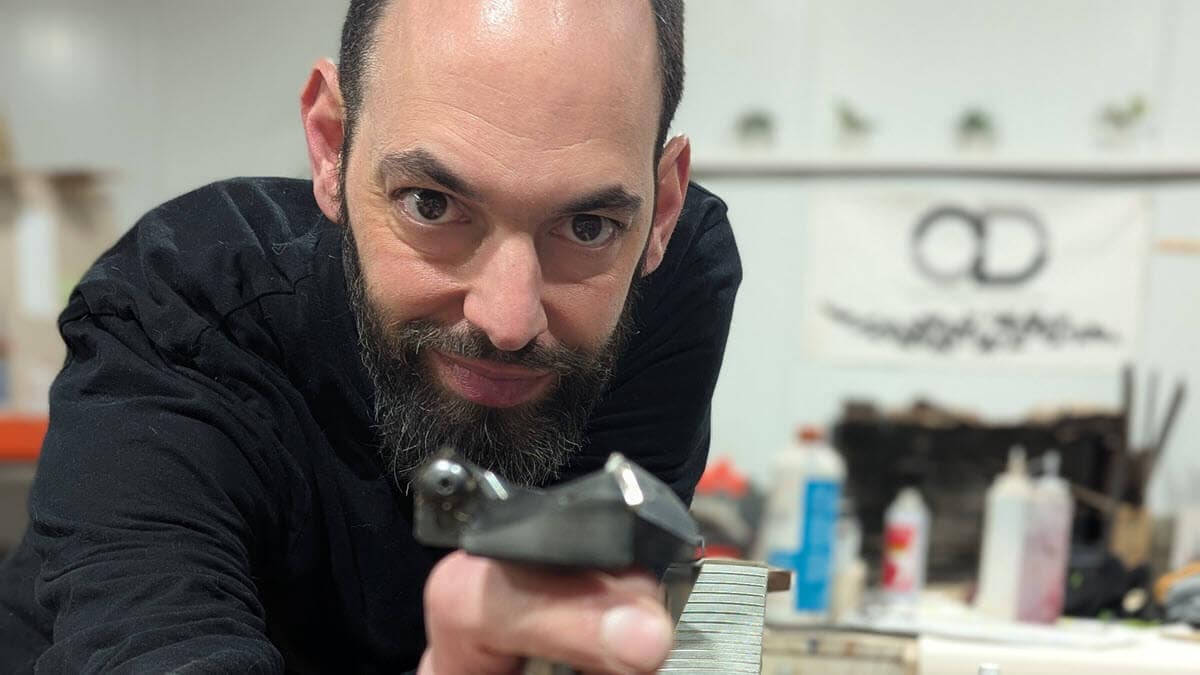
We'd like to thank Yoav Liberman for sharing his time and insights with the ToolsToday community. You can explore more of his furniture, writing, and woodworking projects on yoavliberman.com, follow him on Instagram (@yoav.liberman), or read his articles for Popular Woodworking.