Best Table Saws of 2026: Find the Right Saw for Your Shop
Table of Contents
- Quick Take: Which Table Saw Is Best for You?
- Best Table Saw for Safety: SawStop Contractor Saw
- Best Entry-Level Stationary Table Saw: Laguna Fusion F1
- Best Table Saw for Long-Lasting Value: Powermatic PM2000T
- Best Contractor-Style Table Saw: JET ProShop II
- Best Cabinet Table Saw: JET Deluxe XACTA
- Best Table Saw for a Small Shop: Laguna Fusion F1 or JET ProShop II
- What to Look for When Choosing a Table Saw
- Cabinet Saw vs. Contractor Saw vs. Hybrid Saw
- Which Table Saw Should You Buy?
- FAQs
Ask five woodworkers to name the best table saw, and you may get five different answers.
That is because the best table saw for a professional cabinet shop may be completely wrong for a hobbyist working in a one-car garage. Some buyers prioritize motor power and rip capacity. Others care more about safety, available floor space, electrical requirements, or the ability to move the saw when it is not in use.
Instead of forcing very different machines into a single ranked list, this guide organizes our recommendations by use case. Whether you are furnishing your first serious workshop, upgrading from a portable saw, or choosing a machine for daily production work, the goal is to help you find the table saw that best fits the way you actually work.
All of the table saws featured below are available through ToolsToday from established manufacturers including SawStop, Laguna Tools, JET, and Powermatic.
Quick Take: Which Table Saw Is Best for You?
| If You... | Our Recommendation | Why It Fits |
|---|---|---|
| Put injury prevention first | SawStop Contractor Saw | Patented skin-contact detection and braking technology |
| Want an affordable first stationary saw | Laguna Fusion F1 | Hybrid cabinet construction, cast iron table, and 110V power |
| Want a saw built for many years of heavy use | Powermatic PM2000T | Massive cabinet construction, 5 HP motor, and heavy-duty trunnion |
| Need cabinet-saw features in a smaller machine | JET ProShop II | Compact contractor-style design with a cast iron table and precision features |
| Build furniture or cabinetry at scale | JET Deluxe XACTA | 3 HP motor, 50-inch rip capacity, and extensive cast iron work surface |
| Have limited workshop space | Laguna Fusion F1 or JET ProShop II | Stationary-saw accuracy without the footprint of a full production cabinet saw |
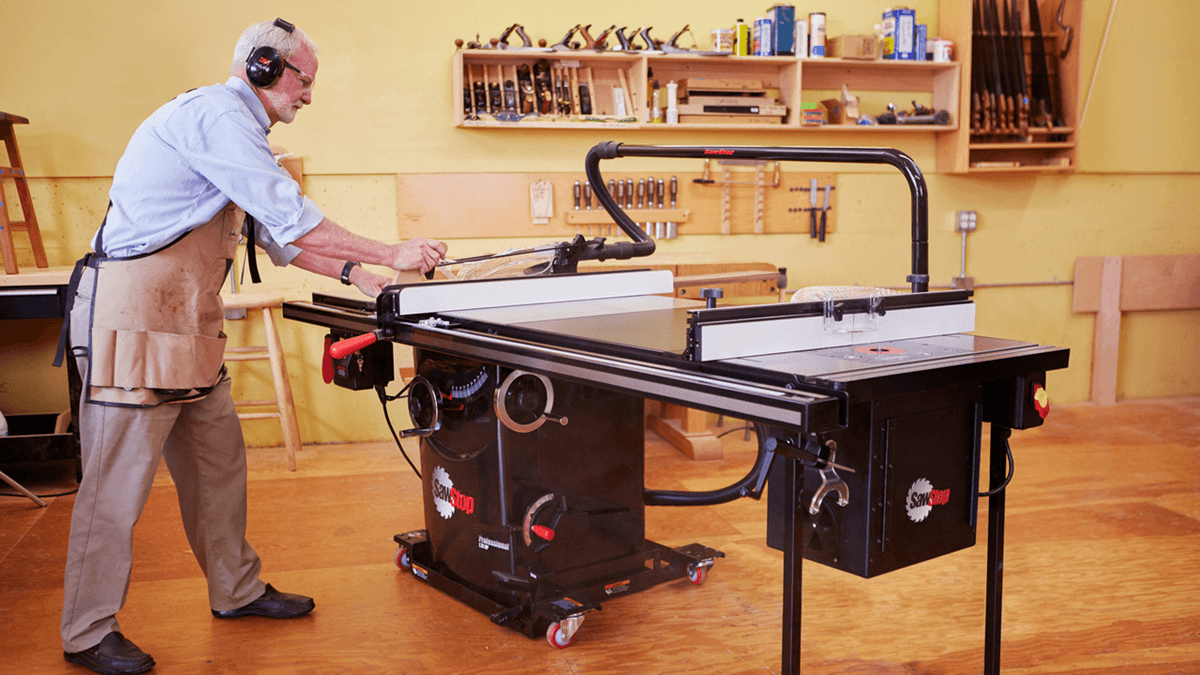
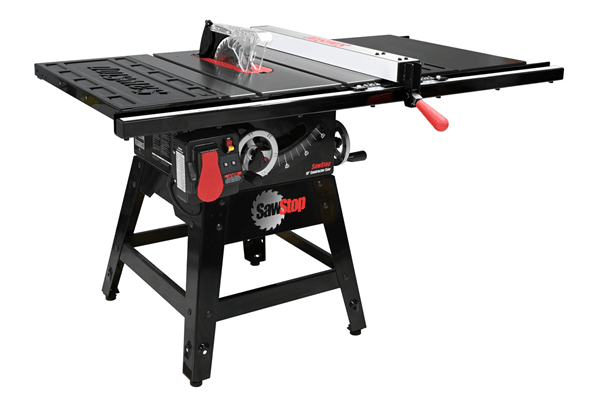 The SawStop® Contractor Saw is SawStop’s most customizable saw. The CNS features better-than-hybrid performance and offers reliability and versatility for a variety of users – delivering the performance you need with the peace of mind only SawStop's revolutionary safety system can provide.
Best Table Saw for Safety: SawStop Contractor Saw
If protection against blade-contact injuries is your highest priority, SawStop is the clear place to begin.
SawStop applies a small electrical signal to the blade. When the spinning blade contacts skin, the change in that signal activates an aluminum brake, stops the blade, and pulls it beneath the table. The complete stop-and-drop sequence occurs in less than five milliseconds.
This system does not replace safe operating practices. You still need to use the blade guard, riving knife, push sticks, proper workpiece support, and sound cutting technique. What SawStop provides is an additional layer of protection when a mistake occurs despite those precautions.
The SawStop CNS175-PFA30 Contractor Saw combines that safety system with a 1.75 HP motor and a 30-inch Premium Fence System. The fence is designed for smooth adjustment, accurate measurement, and secure lockdown without excessive deflection.
The Contractor Saw is also one of SawStop's most configurable models. Its stationary footprint and 1.75 HP motor suit serious home shops and light professional work, while optional mobile bases, cast iron wings, dust-collection components, and other accessories make it possible to tailor the saw to the shop.
Why We Recommend It
- SawStop safety system stops the blade on contact with skin
- 1.75 HP motor operates without the power demands of a large industrial cabinet saw
- 30-inch fence provides useful rip capacity for furniture and general woodworking
- Quick-release safety components and riving-knife compatibility
- Expandable platform with optional mobile, dust-collection, and cast iron accessories
Best for: Safety-conscious hobbyists, school or community workshops, shared shops, small businesses, and anyone who places injury prevention above the lowest possible purchase price.
Keep in mind: A brake activation normally requires replacement of the brake cartridge and may damage the blade. Conductive materials and very wet wood may also require special operating procedures. Always follow the manufacturer's instructions.
Best Entry-Level Stationary Table Saw: Laguna Fusion F1
The Laguna Fusion F1 is one of the most accessible ways to move beyond a portable or benchtop saw without jumping directly to a large 230V cabinet machine.
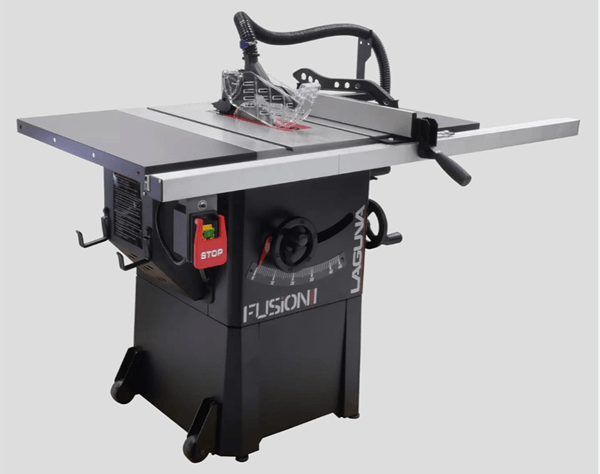
The Laguna Fusion F1 is classified as a hybrid cabinet saw. It combines a partially enclosed cabinet-style base with a polished cast iron table, a 1.5 HP totally enclosed fan-cooled motor, and a 31-inch rip capacity.
Its 110V motor is particularly important for first-shop buyers. Large cabinet saws often require a dedicated 230V circuit, while the Fusion F1 can operate on the type of electrical service more commonly available in a garage or home workshop. A proper circuit is still required, but many buyers will not need to add 230V service before installing the saw.
The F1 also provides features that are often missing from lower-cost portable saws, including a full-size cast iron work surface, a cam-lock T-shaped fence, a riving knife, a quick-release blade guard, and an enclosed dust-collection path. Its 4-inch main dust port and 1-1/2-inch blade-guard port support collection both below and above the table.
At the time of writing, the F1 is listed around $1,399, placing it well below many full cabinet saws. Prices can change, but its broader value proposition remains the same: it gives developing woodworkers a true stationary platform rather than a stripped-down saw they may quickly outgrow.
Why We Recommend It
- 1.5 HP motor with 110V single-phase power
- Polished, precision-ground cast iron table
- 31-inch maximum rip capacity to the right of the blade
- 4-inch lower dust port plus blade-guard dust collection
- Riving knife and quick-release blade guard included
- Smaller cabinet footprint than a heavy production saw
Best for: Hobbyists establishing their first serious shop, woodworkers upgrading from a portable table saw, and buyers who want cabinet-style construction without cabinet-saw pricing or electrical requirements.
Keep in mind: A 1.5 HP motor is well suited to common furniture and home-shop work, but it will not remove material as effortlessly as a 3 HP or 5 HP cabinet saw when ripping thick hardwood throughout the day. Blade sharpness and feed rate become especially important during demanding cuts.
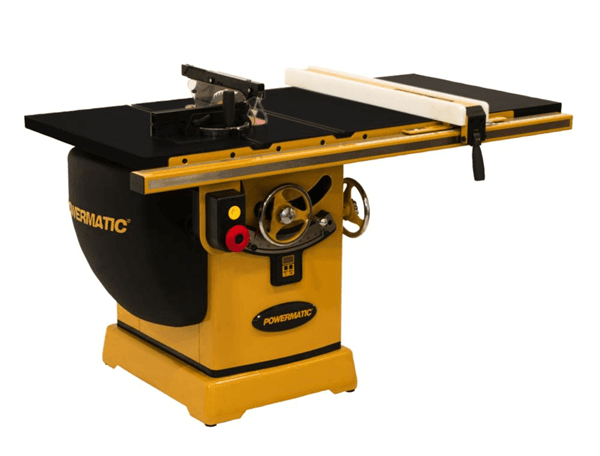 The award-winning Powermatic PM2000T table saw sets a new standard for innovation with an array of patented features and massive body design.
Best Table Saw for Long-Lasting Value: Powermatic PM2000T
The Powermatic PM2000T is built for buyers who measure value over decades of use rather than by the lowest upfront price.
The featured Powermatic PM2000T is a substantial 5 HP cabinet saw operating on 230V single-phase power. It is intended for demanding shops where power, mass, smooth operation, and long-term durability justify a premium investment.
At the center of the saw is a one-piece cast iron box trunnion. Powermatic describes it as providing the strongest stability of any Powermatic table saw. A wide stance and heavy construction help keep the blade assembly stable, while concave trunnion gear teeth are designed to make blade-height and tilt adjustments smoother.
The PM2000T also uses a Poly-V belt drive to transfer power from the motor to the arbor with less vibration, noise, and heat buildup than a less refined drive system. For the operator, that can mean smoother starts, steadier cuts, and less vibration transferred to the workpiece.
Its cast iron work surface is protected with Powermatic's ArmorGlide coating. The low-friction, rust-resistant surface is designed to require less maintenance while allowing stock to slide more easily across the table. Other premium features include a digital bevel readout, an above-table arbor lock, improved cabinet access for dust cleanup, and an integrated hydraulic caster system for moving the saw within the shop.
Why We Recommend It
- 5 HP motor for demanding production work and thick hardwood
- One-piece cast iron box trunnion for stability
- Poly-V belt drive for efficient power transfer with reduced vibration and heat
- ArmorGlide low-friction, rust-resistant cast iron surface
- Digital bevel readout and repeatable angle indicators
- Integrated hydraulic caster system
- 4-inch dust port and improved access to the cabinet interior
Best for: Professional furniture makers, cabinet shops, production environments, and committed woodworkers who want to buy one exceptionally capable stationary saw and keep it for many years.
Keep in mind: This is not simply a more powerful hobby saw. It is a large, heavy machine that requires suitable floor space, dust collection, 230V power, and a properly sized circuit. Make sure the shop can support the saw before ordering it.
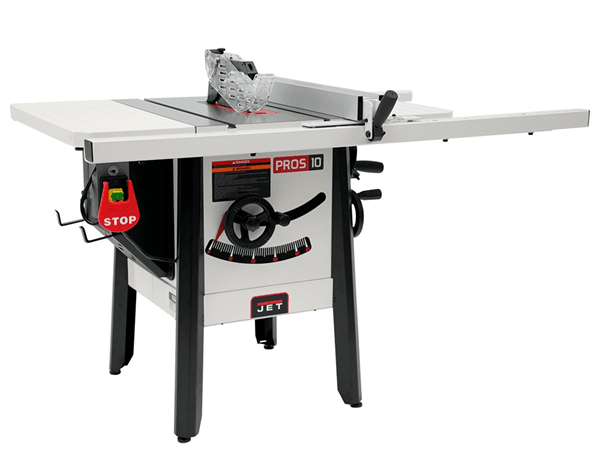 The JET ProShop Table Saw offers features you expect from a high-end cabinet saw, in the compact design of a contractor-style machine.
Best Contractor-Style Table Saw: JET ProShop II
The JET ProShop II combines many of the features associated with cabinet saws with the smaller footprint and 115V power requirements of a contractor-style machine.
The term “contractor saw” can be misleading. Some traditional contractor saws were designed around open stands and rear-mounted motors, while newer models increasingly blend contractor-saw accessibility with hybrid or cabinet-style construction.
The JET ProShop II falls into that newer category. It uses a 1.75 HP, 115V motor, a cast iron table, an improved blade dust shroud, and a compact enclosed base. The featured configuration provides 30 inches of rip capacity, while other ProShop configurations may be available with larger rails.
A redesigned transparent blade guard uses independent leaves that can move with the workpiece rather than lifting the entire guard assembly. The quick-release riving knife can be removed or changed without a lengthy setup, and a separate low-profile riving knife is included for non-through cuts such as grooves and rabbets.
The single-belt drive simplifies belt tensioning and helps reduce vibration. Other practical features include a magnetic paddle switch, an arbor lock for faster blade changes, and onboard storage for the included accessories.
Why We Recommend It
- 1.75 HP motor operating on 115V power
- 30-inch rip capacity in the featured configuration
- Cast iron table
- Quick-release standard and low-profile riving knives
- Independent-leaf transparent blade guard
- Improved dust shroud with a 4-inch dust port
- Single-belt drive designed for easier tensioning and reduced vibration
Best for: Remodelers with a home base, small professional shops, serious hobbyists, and woodworkers who need a compact stationary saw with features typically associated with larger machines.
Keep in mind: Contractor-style does not necessarily mean jobsite portable. The ProShop II is smaller and more manageable than a heavy cabinet saw, but it is still a cast iron stationary machine. Add an appropriate mobile base when the saw must be repositioned regularly.
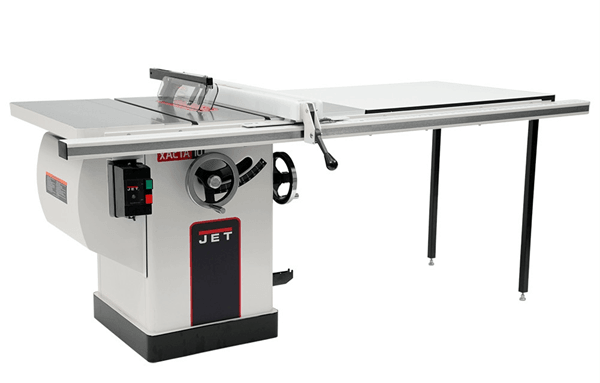 The Jet Deluxe XACTA® saw offers an upgraded Poly-V belt drive system for smooth operation and optimal power transfer. The 26" x 30" wings and deeper table gives you even more cast iron to work on.
Best Cabinet Table Saw: JET Deluxe XACTA
The JET Deluxe XACTA is the strongest fit here for woodworkers who need 3 HP power, a broad cast iron work surface, and enough rip capacity to process large panels and cabinetry components.
A true cabinet saw places the motor and trunnion assembly inside an enclosed cabinet. Compared with lighter saw designs, this construction generally provides greater mass, improved rigidity, better dust containment, and more power for repeated cuts in thick stock.
The JET Deluxe XACTA 10-inch Cabinet Saw uses a 3 HP motor operating on 230V power and provides 50 inches of rip capacity to the right of the blade. That wide capacity is especially useful when breaking down sheet goods or cutting repeated cabinet panels without constantly reconfiguring the work area.
JET equips the saw with left and right cast iron extension wings. The 26-by-30-inch wings and deeper working surface give the operator more cast iron support around the blade, which is valuable when controlling long or heavy workpieces.
Below the table, a Poly-V belt drive supports smooth power transfer. The fully shrouded blade directs dust toward the 4-inch collection port, while the wide-stance trunnion supports stable blade positioning. Onboard storage keeps the fence and miter gauge with the machine when they are not being used.
Why We Recommend It
- 3 HP motor for regular hardwood and production work
- 50-inch maximum rip capacity
- Left and right cast iron extension wings
- Poly-V belt drive for smooth power transfer
- Fully shrouded blade and 4-inch dust port
- Quick-release riving knife and push-button arbor lock
- Onboard fence and miter-gauge storage
Best for: Furniture makers, cabinet builders, professional woodshops, and serious home shops that routinely cut large panels, thick hardwood, or repeated project components.
Keep in mind: A wide rip fence helps position large sheet goods, but the extension table alone does not fully support an entire sheet. Plan for adequate infeed and outfeed support, particularly when working alone.
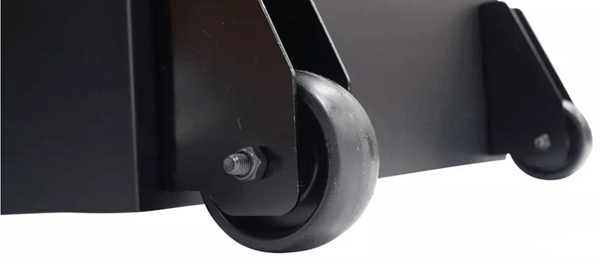 Maximizing a small shop layout: The Laguna Fusion F1 features an optional, bolt-on wheel system that grants quick mobility without compromising the table saw’s cutting stability.
Best Table Saw for a Small Shop: Laguna Fusion F1 or JET ProShop II
For a small shop, the best saw is not necessarily the smallest machine—it is the smallest saw that still provides the stability, fence accuracy, power, and work surface your projects require.
A portable benchtop saw saves floor space, but the tradeoffs may include a smaller table, a shorter fence, greater vibration, and less support for furniture components or sheet goods. For many garage and basement shops, a compact stationary saw on a mobile base is a better long-term answer.
The Laguna Fusion F1 is the stronger choice when budget and overall footprint are the main concerns. Its hybrid cabinet construction, cast iron table, 31-inch rip capacity, and 110V motor create a useful bridge between portable and full cabinet saws.
The JET ProShop II is the better fit when you want a little more motor power, a compact contractor-style format, and features such as a low-profile riving knife and independent-leaf blade guard.
Whichever model you select, the layout of the room matters as much as the physical size of the machine. A table saw needs clear space in front of and behind the blade for the longest boards you plan to cut. It also needs adequate side clearance for rip cuts and a safe place for the operator to stand.
Small-Shop Setup Tips
- Place the saw on a compatible mobile base so open floor space can serve multiple purposes.
- Use a mobile workbench or assembly table as outfeed support.
- Choose 30- or 31-inch rails unless you regularly need greater rip capacity.
- Measure the entire operating envelope, not just the cabinet footprint.
- Plan dust-collection hose routing before choosing the saw's permanent position.
- Confirm that doors, stairs, and hallways can accommodate the machine during delivery.
Best for: Garage shops, basement workshops, multipurpose spaces, and woodworkers who need cabinet-saw stability without dedicating an entire room to one machine.
What to Look for When Choosing a Table Saw
Product specifications are useful, but they only become meaningful when matched to the work you intend to do. Before comparing individual models, answer the following questions about your shop and projects.
1. How Much Power Do You Need?
A 1.5 to 1.75 HP table saw can handle most furniture projects, sheet goods, and common hardwood cutting when paired with a sharp, appropriate blade. These motors also commonly operate on 110V or 115V power, making them practical for home workshops.
A 3 HP cabinet saw is better suited to frequent use, thick hardwood, and production environments where the saw must maintain cutting speed throughout the day. A 5 HP machine provides still more reserve power, but it also adds cost, weight, and electrical requirements that many hobby shops do not need.
More horsepower does not automatically produce a cleaner cut. Fence alignment, blade selection, machine setup, feed technique, and workpiece support all affect the result.
2. How Much Rip Capacity Do You Actually Need?
Rip capacity is the maximum distance between the blade and fence. A 30- or 31-inch capacity is enough for a wide range of furniture parts, shelving, solid lumber, and smaller panels.
A 50- or 52-inch fence allows the blade to reach beyond the center of a standard 4-by-8-foot sheet. That can be useful in cabinet and production shops, but it also makes the saw substantially wider.
Before choosing the largest available fence, ask how often you will truly use it. Many small-shop woodworkers break full sheets into manageable sections with a track saw or circular saw, then bring the smaller panels to the table saw for final sizing.
3. How Rigid Is the Fence?
The fence is one of the most important components on a table saw. It should move smoothly, lock securely, remain parallel to the blade, and resist deflection as stock is fed through the cut.
A powerful motor cannot compensate for a fence that shifts under pressure. When comparing two otherwise similar saws, give serious weight to the quality of the fence, rails, locking mechanism, and adjustment system.
4. Which Safety Features Are Included?
At minimum, a modern table saw should include a riving knife and blade guard. The riving knife follows the blade through height and bevel adjustments, helping prevent the freshly cut kerf from closing against the rear teeth of the blade and causing kickback.
A low-profile riving knife is useful for non-through cuts in which the blade does not pass completely through the top of the material. Quick-release systems make it easier to change between the blade guard, standard riving knife, and low-profile knife as the operation requires.
SawStop adds active blade-contact detection and braking. That technology provides a different level of protection, but it does not eliminate kickback hazards or the need to use conventional guards and safe operating procedures.
5. How Is Dust Collected?
Table saws produce dust both below and above the table. A lower cabinet port collects material falling beneath the blade, while a shrouded blade helps direct airborne particles toward that port.
Overarm or blade-guard collection captures dust closer to the point of generation. Systems that combine upper and lower collection generally control fine airborne dust more effectively than a single open port beneath the saw.
Check the port diameter and recommended airflow before purchasing. A large port offers limited benefit when connected to an undersized shop vacuum or a dust collector that cannot supply the required airflow.
6. Does the Saw Fit Your Electrical Service?
Do not assume that every table saw can plug into an existing garage outlet. Smaller stationary saws may operate on 110V or 115V power, but they can still require a dedicated 20-amp circuit.
Larger cabinet saws commonly require 230V power and may need a 20- or 30-amp circuit depending on the motor. Verify the manufacturer's requirements and consult a qualified electrician when adding or modifying shop wiring.
7. Will the Saw Stay in One Place?
A large cabinet saw delivers stability partly because of its mass. That advantage becomes a challenge when the shop needs to serve multiple purposes.
Some stationary saws accept manufacturer-specific mobile bases, while others can be placed on properly rated universal bases. Make sure the base supports the full machine weight and locks securely before operating the saw.
For true jobsite portability, look beyond the saws featured here to a purpose-built portable or compact table saw with a folding or rolling stand.
Cabinet Saw vs. Contractor Saw vs. Hybrid Saw
| Saw Type | Typical Strengths | Potential Tradeoffs | Best Suited To |
|---|---|---|---|
| Cabinet Saw | High power, mass, stability, broad work surface, and enclosed dust collection | Higher price, larger footprint, heavy weight, and often 230V power | Professional shops and demanding furniture or cabinet work |
| Contractor-Style Saw | Smaller footprint, accessible power requirements, and easier mobility | Less mass and motor power than a large cabinet saw | Home shops, light professional use, and flexible workshop layouts |
| Hybrid Saw | Cabinet-like base and table with lower cost and electrical demands | May not match the power or mass of a true production cabinet saw | Serious hobbyists and first-time stationary-saw buyers |
| Portable or Jobsite Saw | Easy transportation, compact storage, and fast setup | Smaller table and fence, more vibration, and less support for large stock | Jobsites, installation work, and shops with very limited storage |
Which Table Saw Should You Buy?
There is no single table saw that is best for every woodworker. There is only the saw that best matches your work, workspace, electrical service, safety priorities, and budget.
- Choose the SawStop Contractor Saw when active blade-contact protection is the deciding factor.
- Choose the Laguna Fusion F1 when you want an affordable first stationary saw with 110V power.
- Choose the Powermatic PM2000T when you want maximum power, heavy construction, and long-term production value.
- Choose the JET ProShop II when you need cabinet-style features in a more compact contractor configuration.
- Choose the JET Deluxe XACTA when 3 HP power, 50-inch rip capacity, and a large cast iron work surface fit your furniture or cabinetry workflow.
Before making the final decision, measure the shop, confirm the electrical requirements, and think honestly about the largest material you cut regularly—not the largest project you might attempt someday.
Shop all table saws at ToolsToday and compare available models from SawStop, Powermatic, JET, Laguna Tools, and other professional woodworking brands.
Product specifications, prices, and availability may change. Always review the current product listing and manufacturer documentation before purchasing or operating a table saw.
FAQs
What is the best table saw for woodworking?
The best table saw depends on your workspace and the type of woodworking you do. A 1.5 to 1.75 HP hybrid or contractor-style saw is often enough for a home furniture shop, while a 3 HP or 5 HP cabinet saw is better suited to frequent production work and thick hardwood.
What is the difference between a cabinet saw and a contractor saw?
A cabinet saw encloses the motor and trunnion assembly in a heavy cabinet, providing greater mass, power, stability, and dust containment. A contractor-style saw is generally lighter, smaller, and easier to power or reposition, although modern contractor and hybrid saws may include many cabinet-saw features.
Is a SawStop table saw worth the extra cost?
A SawStop may be worth the added cost when protection from blade-contact injuries is a leading priority, particularly in shared, educational, family, or professional shops. The braking system does not replace safe technique, blade guards, or riving knives, but it adds protection that conventional table saws do not provide.
What is the best table saw for a small woodworking shop?
The Laguna Fusion F1 and JET ProShop II are strong choices for small shops because they combine cast iron tables and precision fences with smaller footprints than large cabinet saws. Pairing either one with a mobile base and a multipurpose outfeed table can make better use of limited floor space.
How much rip capacity do I actually need?
A 30- or 31-inch rip capacity is sufficient for most furniture parts, shelving, solid lumber, and smaller panels. Consider a 50- or 52-inch fence when you routinely process wide cabinetry components or need to rip beyond the center of full sheet goods on the table saw.
Can I upgrade a table saw's fence or safety features later?
Many table saws can accept an aftermarket fence, mobile base, extension table, or improved dust-collection accessories. Conventional safety components may also be replaceable, but a flesh-detection braking system cannot normally be added to a non-SawStop saw because it is integrated into the machine's design.
Is a 10-inch table saw large enough for most woodworking?
Yes. A 10-inch table saw is the standard choice for most home and professional woodworking and typically provides approximately 3-1/8 inches of cutting depth at 90 degrees. The correct blade type, tooth configuration, and kerf are often more important than moving to a larger blade diameter.