Table Saw vs. Miter Saw: Which Is Right for Your Projects?
Table of Contents
Choosing between a table saw and a miter saw is not simply a matter of comparing features. The saw you buy first will determine which kinds of projects you can complete most efficiently, accurately, and safely.
Buy a table saw first if you plan to build furniture or cabinets, resize boards, or regularly work with plywood and other sheet goods.
Buy a miter saw first if your projects primarily involve trim, molding, flooring, framing, decking, or repeated crosscuts in dimensional lumber.
Although these saws overlap in a few areas, they solve different problems. A table saw excels at making long, straight cuts and sizing material to width. A miter saw makes fast, accurate cuts across boards and at precise angles.
Table Saw vs. Miter Saw: Quick Comparison
| Project or Feature | Table Saw | Miter Saw |
|---|---|---|
| Primary purpose | Rip cuts and sizing material to width | Crosscuts, miters, bevels, and compound angles |
| Furniture building | Best choice | Useful for cutting stock to length |
| Cabinetmaking | Best choice | Limited supporting role |
| Trim and molding | Possible, but inefficient | Best choice |
| Framing and decking | Useful for some rip cuts | Best choice |
| Flooring | Limited use | Best choice |
| Sheet goods | Excellent with proper support | Not practical |
| Rip cuts | Excellent | Not designed for rip cuts |
| Crosscuts | Good with a sled or miter gauge | Excellent |
| Angled cuts | Possible, but less convenient | Excellent |
| Material movement | The workpiece moves past the blade | The blade moves through the stationary workpiece |
| Portability | Ranges from portable to stationary | Generally portable |
| Learning curve | Higher, especially because of kickback risk | Generally easier for beginners |
| Common blade choice | Rip, combination, or general-purpose blade | Crosscut or fine-finish blade |
What Is a Table Saw?
A table saw has a circular blade mounted beneath a flat work surface. The blade projects through an opening in the table, and the operator guides the material past it.
Its primary job is making rip cuts: long cuts made parallel to the wood grain. A rip fence keeps the workpiece at a consistent distance from the blade, allowing boards and panels to be cut to a precise width.
A table saw can also make crosscuts with a miter gauge or crosscut sled. Depending on the saw and blade setup, it may also cut bevels, grooves, dados, rabbets, and certain types of joinery.
What Is a Table Saw Best Used For?
A table saw is best for resizing material, producing straight parallel edges, and making repeatable cuts to width.
- Building furniture, cabinets, bookcases, and shelving
- Ripping hardwood boards to width
- Cutting plywood and other panel products
- Producing multiple matching parts
Table saws range from portable jobsite models to heavy cabinet saws. The differences in size, motor power, rip capacity, fence design, and mobility are better addressed in a dedicated Table Saw Buying Guide (coming soon).
Safety-focused models, including SawStop table saws, add flesh-detection technology to conventional features such as a blade guard and riving knife.
What Is a Miter Saw?
A miter saw also uses a circular blade, but the workpiece remains against a rear fence while the operator lowers the blade through it. The user positions the board at the required length and brings the saw head down to make the cut.
A miter saw is designed primarily for crosscuts, which run across the width of a board. It can also rotate or tilt to create miter cuts, bevel cuts, and compound angles.
What Is a Miter Saw Best Used For?
A miter saw is best for cutting boards to length and producing accurate angles in trim, molding, framing lumber, and dimensional stock.
- Cutting baseboard, crown molding, and door or window trim
- Framing walls, decks, sheds, and outdoor structures
- Installing flooring
- Making picture frames and repeated crosscuts
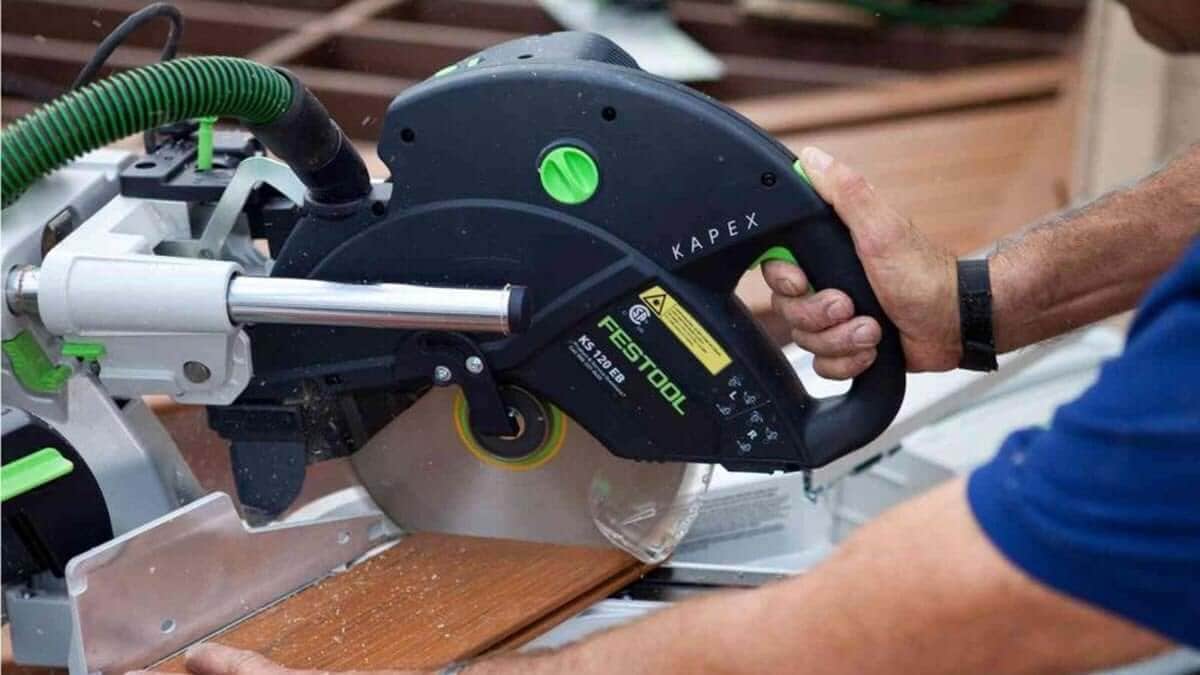
Miter saws are available in sliding and non-sliding designs, with different cutting capacities and bevel ranges. Premium models such as the Festool KAPEX add features intended to improve precision, adjustment, compactness, and dust collection.
A miter cut angles across the face of the board. A bevel cut angles through its thickness. A compound cut combines both angles, which is particularly useful for crown molding and other complex trim work.
Which Saw Should You Buy?
Furniture and Cabinetry: Choose a Table Saw
A table saw is usually the better first purchase for furniture and cabinet work. These projects depend on straight, repeatable cuts in plywood, MDF, hardwood, and other panel products. Parts often need to be ripped to an exact width, squared, and reproduced consistently.
A miter saw can cut long stock into manageable sections, but it cannot replace the table saw for ripping boards, sizing panels, or producing matching components.
Full sheets of plywood can be difficult to control on a compact table saw. Many woodworkers first break down large sheets with a track saw, then use the table saw for final sizing and repeated cuts.
Trim, Molding, and Picture Frames: Choose a Miter Saw
A miter saw is the clear choice for trim work. It makes fast, accurate crosscuts, miters, bevels, and compound angles while allowing the user to work from measurement marks or stop blocks.
The same control over angles makes it suitable for crown molding, baseboard, picture frames, door casings, and window trim.
Framing, Decking, and Flooring: Choose a Miter Saw
These projects involve frequent crosscuts in dimensional lumber. A miter saw allows boards to be placed against the fence and cut to length rapidly. It is also useful for angled cuts in rafters, braces, and deck components.
For flooring installation, a portable miter saw can be positioned close to the work area, avoiding repeated trips to a stationary machine.
General DIY Projects: It Depends
For trim repairs, framing, outdoor projects, or shelving made from pre-sized lumber, a miter saw may be used more frequently.
For furniture, cabinets, workshop fixtures, or projects that require changing the width of boards and panels, a table saw offers more useful capability.
If your work centers on sheet goods, furniture, cabinetry, and rip cuts, choose a table saw.
If your work centers on dimensional lumber, trim, flooring, framing, and cutting boards to length, choose a miter saw.
Do You Eventually Need Both?
Many workshops eventually include both because the two saws complement each other.
A furniture maker might cut a long board into manageable sections on the miter saw, then rip those sections to final width on the table saw. Final crosscuts can be made with the miter saw or a table saw sled, depending on the part and required precision.
A home renovator may use the tools differently: the miter saw handles most trim and framing work, while the table saw is used occasionally to resize shelving, panels, or filler strips.
You do not need both immediately. As your projects become more varied, the limitations of the saw you already own will usually make it clear when the second tool would improve your workflow.
Table Saw and Miter Saw Safety
Both machines require careful setup and disciplined operating habits. Follow the manufacturer’s instructions, use the supplied safety equipment, wear eye and hearing protection, and disconnect power before changing blades or making adjustments.
Table Saw Safety
The primary table saw hazard is kickback, which occurs when the workpiece is caught, pinched, or rotated into the rear of the spinning blade and thrown toward the operator.
A properly aligned fence, riving knife, blade guard, and correct feeding technique help reduce the risk. Use push sticks or push blocks for narrow stock, and keep your hands away from the cutting path.
Large boards and full sheets also require adequate support. Unsupported material can tip, twist, bind, or pull the operator off balance.
Miter Saw Safety
Keep the workpiece firmly against the fence and keep your hands outside the designated cutting zone. Use clamps or hold-downs for short, narrow, or awkward material.
Support long boards so they remain level with the saw table. After completing the cut, release the trigger and keep the saw head lowered until the blade stops.
Before starting the saw, confirm that the blade will clear the fence, throat plate, clamps, stops, and accessories, particularly during bevel or compound cuts.
Common Beginner Mistakes
- Trying to rip a board on a miter saw: A miter saw cuts across material and should not be used for rip cuts.
- Crosscutting long stock improperly on a table saw: Use a miter gauge, crosscut sled, and adequate support rather than relying on the rip fence alone.
- Handling full sheets without enough support: Stated rip capacity does not guarantee that a large panel will be safe or manageable.
- Using the wrong blade: A rip blade may leave rough crosscuts, while a fine-finish blade may cut slowly or generate excess heat during heavy ripping.
- Assuming factory settings are perfect: Check fence alignment, angle stops, and bevel settings before beginning precision work.
The Right Saw Blade Matters
The saw supplies the power, but the blade has a major influence on cut quality, speed, tearout, heat, and motor load.
- Rip blades cut efficiently along the wood grain.
- Crosscut blades generally use more teeth for cleaner cuts across the grain.
- Combination blades handle both rip cuts and crosscuts reasonably well.
- Fine-finish blades help reduce chipping and tearout in trim, molding, plywood, and finished materials.
Even a premium saw may produce disappointing results with a dull or poorly matched blade. Before choosing one, confirm the required diameter, arbor size, kerf, tooth count, tooth geometry, and material compatibility.
For more detail, see Choosing the Right Saw Blade for Every Project.
Final Thoughts: Table Saw or Miter Saw?
Choose a table saw if your work depends on ripping boards, sizing panels, building furniture, or producing repeated straight cuts.
Choose a miter saw if you primarily need fast crosscuts, miters, bevels, and compound angles for trim, framing, flooring, or renovation projects.
Many woodworkers eventually benefit from owning both. Whichever saw you purchase first, pair it with the correct blade, learn the machine’s safety procedures, and use proper material support and work-holding accessories.
FAQs
Can I cut plywood without a table saw?
Yes. If you occasionally need to cut plywood or other large sheet goods but don't have room for a table saw, a track saw is an excellent alternative. It produces long, accurate cuts while taking up very little shop space.
Many woodworkers use a track saw to break down full sheets into manageable panels, then use a table saw—or other shop tools—for final sizing and joinery. If your projects regularly involve ripping lumber, producing identical parts, or building cabinets, a table saw will still be the more versatile long-term solution.
Can a miter saw replace a table saw?
Not completely. A miter saw is designed for crosscuts, miters, bevels, and compound cuts, making it ideal for trim, molding, framing, flooring, and cutting boards to length. However, it cannot safely make long rip cuts or resize sheet goods. If you build furniture or cabinets, a table saw is usually the better long-term investment.
Is a 10-inch table saw enough for most woodworking?
Yes. A 10-inch table saw is the standard size for both hobbyists and professionals. It has enough cutting capacity for most furniture, cabinetry, home improvement, and general woodworking projects. The quality of the blade and the saw's fence system often have a greater impact on results than blade diameter alone.
Do I need both a table saw and a miter saw?
Not at first. Most woodworkers start with the saw that best matches the projects they build most often. As your skills and project types expand, many workshops eventually add the second saw because each excels at different tasks. A miter saw is excellent for cutting material to length, while a table saw handles ripping and precise sizing.
Does the saw blade really make that much difference?
Absolutely. Even an excellent saw can produce poor results with the wrong blade. Rip blades are designed for cutting with the grain, while crosscut blades produce cleaner cuts across the grain. Combination blades offer a good balance for general woodworking, and fine-finish blades help reduce tearout in plywood, trim, and moldings. Choosing the right blade can improve cut quality, reduce strain on the saw, and extend blade life.