How to Cut Melamine Without Chipping: Blade & Setup Tips
Table of Contents
- Why Does Melamine Chip When You Cut It?
- Which Side of Melamine Should Face Up When Cutting?
- What's the Best Blade for Cutting Melamine?
- How to Cut Melamine Without Chipping: Step by Step
- How to Cut Melamine with Different Saws
- Melamine Cutting Problems: Causes and Fixes
- When Is a Dedicated Melamine Blade Worth Buying?
- Clean Melamine Cuts Start with the Right Combination
- FAQs
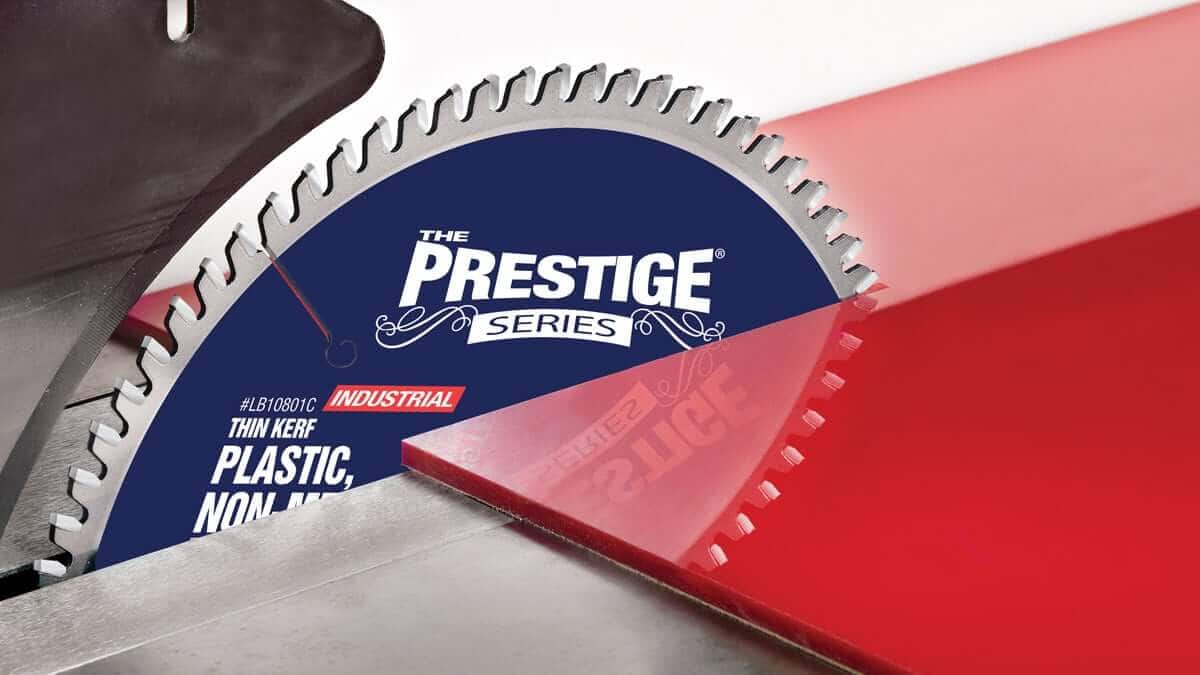
To cut melamine without chipping, use a sharp, fine-finish blade designed for laminated panels, preferably a high alternate top bevel (Hi-ATB) melamine blade. Support the panel close to the cut, use a zero-clearance insert or splinter guard where possible, and maintain a steady feed rate. For clean edges on both faces, a dedicated double-face melamine blade can make a significant difference.
If you've ever cut melamine shelving or cabinet panels and ended up with ragged white edges, you know how frustrating this material can be. The good news is that chipped melamine isn't inevitable. Whether you're using a circular saw, track saw, or table saw, the right blade and setup can dramatically improve your results.
Why Does Melamine Chip When You Cut It?
Melamine-faced panels typically consist of a particleboard or MDF core covered with a thin, hard decorative surface. That surface is durable in everyday use, but it's also brittle. Unlike solid wood, which has fibers that a saw tooth can slice through, melamine can fracture into tiny chips as the blade passes through it.
Chipping is especially common where the saw teeth exit the panel. As each tooth breaks through the surface, it can lift and fracture the coating if the material isn't adequately supported.
Several factors make the problem worse:
- The wrong blade: Coarse-tooth framing and general-purpose blades can tear the coating instead of slicing it cleanly.
- Dull or dirty teeth: Worn cutting edges require more force and can fracture the surface.
- Insufficient support: Gaps around the blade allow the brittle coating to break away.
- Vibration or misalignment: Blade wobble, panel movement, or an improperly aligned fence can damage the cut edge.
- Inconsistent feeding: Forcing the panel or hesitating during the cut can produce rough edges or burning.
The solution isn't simply to use more teeth. Tooth geometry, blade stability, panel support, and cutting technique all matter.
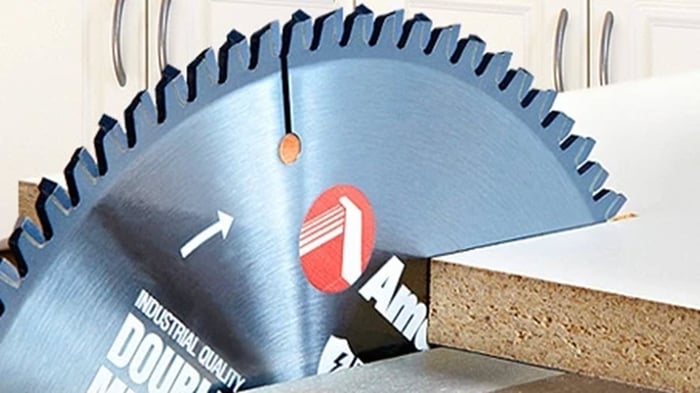
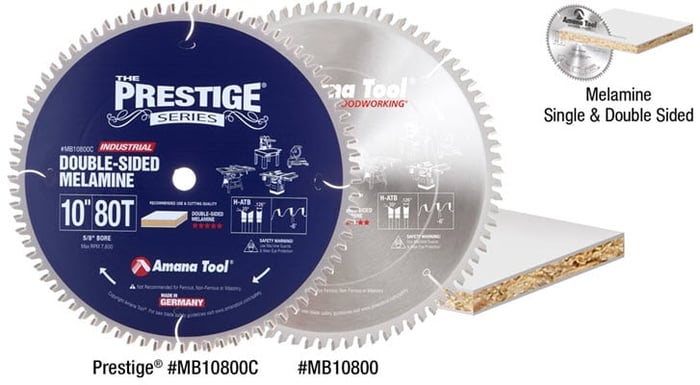 Double-Face Melamine & Laminate Saw Blades Specifically designed to cut melamine chip-free on both sides. Special High-ATB grind (with 25 degree bevels) slices cleanly through fragile surface coatings like melamine and laminate.
 Which Side of Melamine Should Face Up When Cutting?
The best face orientation depends on your saw. On a conventional table saw, the teeth enter through the top surface and exit underneath, so the good face should generally face up. With a handheld circular saw, the opposite happens: the teeth enter from underneath and exit through the top surface, so the good face should generally face down. The surface where the teeth exit is more vulnerable to chipping.
| Saw Type | Recommended Orientation | Why |
|---|---|---|
| Table saw | Good face up | Teeth generally enter the top surface and exit underneath. |
| Handheld circular saw | Good face down | Teeth enter from below and exit through the top surface. |
| Track saw | Good face down as a starting point | A splinter guard can also protect the top surface, making clean cuts on both faces more achievable. |
| Sliding table saw with scoring blade | Either face, with proper setup | The scoring blade helps prevent underside chipping before the main blade cuts through. |
Important: These are general rules for conventional saw configurations, not guarantees. A properly adjusted splinter guard, scoring system, or double-face melamine blade can substantially improve the exit-side edge. Always test your setup on scrap before cutting finished cabinet parts.
What's the Best Blade for Cutting Melamine?
For most woodworkers, a dedicated melamine saw blade is the most reliable upgrade when ordinary fine-finish blades still leave chipped edges.
The best blade isn't necessarily the one with the most teeth. Look at the tooth grind, hook angle, sharpness, blade stability, and whether the manufacturer specifically recommends it for single-face or double-face melamine cutting.
Hi-ATB Blades: Designed for Clean, Crisp Edges
A high alternate top bevel (Hi-ATB) blade has teeth ground at steep alternating angles. These sharp bevels slice through brittle coatings rather than striking them with a relatively blunt cutting edge.
Hi-ATB blades are particularly effective on melamine, laminated panels, and veneered sheet goods. Some are specifically engineered to cut both faces cleanly without a separate scoring blade.
For example, the Amana Tool MB10800C 10-inch double-face melamine blade uses 80 teeth with a 25-degree Hi-ATB grind, a negative 6-degree hook angle, and a heavy-duty plate designed for stability.
Its double-face design is intended to produce clean cuts on both surfaces when the table saw is properly aligned and the blade runs true.
TCG Blades: Durable Cutting for Laminated Materials
Triple chip grind (TCG) blades alternate between a chamfered tooth and a flat-topped finishing tooth. This geometry distributes cutting loads and is often used for abrasive materials, including certain laminates and composite panels.
TCG blades can provide good results in melamine, especially when paired with a scoring system. However, they aren't automatically better than Hi-ATB blades for minimizing chipping on both faces. Choose a TCG blade specifically rated for your material and saw.
How Many Teeth Do You Need to Cut Melamine?
For a 10-inch table saw, an 80-tooth fine-finish or melamine blade is a common choice. But tooth count alone doesn't determine cut quality. A purpose-designed 80-tooth Hi-ATB blade may outperform a higher-tooth-count blade intended for a different material.
Smaller circular and track saw blades require different tooth counts because their diameters and cutting geometries differ. Follow the blade manufacturer's recommendations rather than applying the 80-tooth rule to every saw.
Why Hook Angle and Blade Stability Matter
The hook angle describes how aggressively a saw tooth engages the material. Low or negative hook angles are common on some dedicated melamine blades because they provide a less aggressive cutting action.
A stable blade plate also matters. Excessive deflection or vibration can cause the teeth to strike the coating unevenly. Quality melamine blades may use heavier plates, expansion slots, or vibration-damping features to help maintain a consistent cut.
Melamine Saw Blade Comparison
| Blade Type | Best For | Expected Edge Quality |
|---|---|---|
| Double-face Hi-ATB melamine blade | Cabinet panels, shelving, and melamine-faced sheet goods | Designed for clean cuts on both faces with proper setup |
| TCG laminate or panel blade | Abrasive laminated materials and production cutting | Good results possible; double-face performance depends on blade and scoring setup |
| Standard ATB fine-finish blade | Occasional melamine cuts and general finish work | Often good on the supported face; opposite face may chip |
| Combination or general-purpose blade | General woodworking | Greater risk of visible chipping, especially on the exit side |
| Dedicated track saw melamine blade | Portable sheet-good cutting | Excellent potential with a correctly fitted splinter guard and suitable blade |
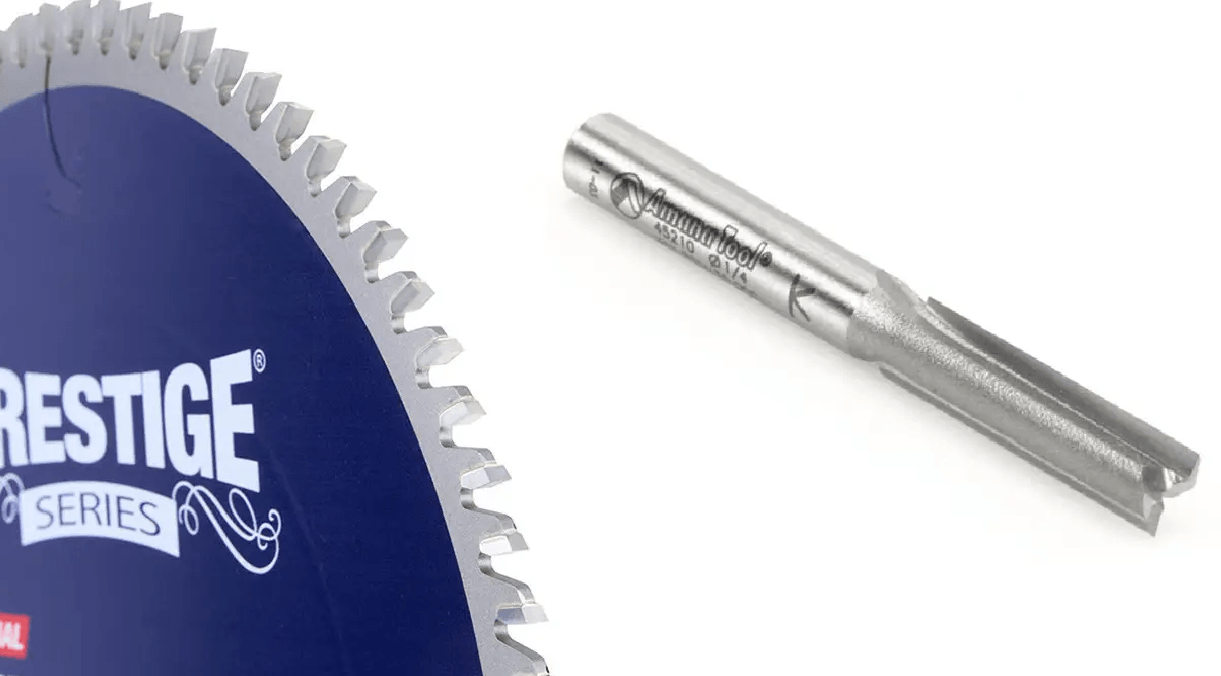
Explore melamine saw blades at ToolsToday to compare specialized blades for cabinetmaking, panel cutting, and other laminated materials.
How to Cut Melamine Without Chipping: Step by Step
Before replacing your blade, try improving your setup and cutting technique. Even a good melamine blade performs better when the panel is stable and the cut is properly supported.
- Inspect and clean the blade. Unplug the saw or disconnect power before inspecting it. Check for dull, chipped, or dirty teeth. Remove resin buildup with a blade cleaner approved by the manufacturer, or replace a damaged blade.
- Mark the cut and support the entire panel. Use a straightedge to mark your cut. Support large sheets on a stable work surface, sacrificial cutting surface, or properly positioned supports. Make sure neither the main panel nor the offcut can shift, sag, or pinch the blade.
- Orient the panel correctly. On a conventional table saw, place the best face up. With a handheld circular saw, place the best face down. For a track saw, consider the condition of the splinter guard and test both surfaces on scrap.
- Use a zero-clearance insert or splinter guard. On a table saw, a compatible zero-clearance throat plate supports the material immediately beside the blade. On a track saw, a properly fitted splinter guard reduces breakout along the top edge.
- Score the surface when appropriate. A dedicated scoring blade on a panel saw is highly effective. For some handheld cutting setups, a carefully controlled shallow scoring pass can help, but it must follow the saw manufacturer's instructions and remain precisely aligned with the final cut.
- Cut with a smooth, steady feed rate. Let the blade do the work. Don't force the panel through the saw or stop unnecessarily in the middle of a cut. Maintain control and use appropriate push sticks, guards, and guides.
- Inspect the cut edge. Check both faces for chips, roughness, or burning. If the result isn't acceptable, adjust the setup and test again before cutting your finished pieces.
Does Painter's Tape Prevent Melamine Chipping?
Painter's tape applied along the cut line may help hold down small fragments of the surface coating, particularly during occasional cuts with a handheld saw. Use a low-tack tape suitable for the surface and remove it carefully.
However, tape provides limited support against the force of the saw teeth. It won't compensate for a dull blade, excessive vibration, or poor panel support. Think of it as a supplemental trick, not a substitute for proper cutting equipment.
How to Cut Melamine with Different Saws
Cutting Melamine with a Circular Saw
A handheld circular saw is often the most accessible tool for cutting melamine shelving, closet panels, and cabinet parts. It can produce clean results, but controlling the panel and protecting the top surface are especially important.
- Place the good face down for a typical handheld circular saw.
- Use a sharp, fine-finish blade approved for melamine or laminated panels.
- Clamp a straightedge guide to maintain a straight cut.
- Support the sheet securely without obstructing the blade path.
- Use a compatible splinter-reducing base or guide system if available.
Because a handheld circular saw's teeth typically exit through the upper surface, the top edge may still chip even when the underside looks clean. If both faces will be visible, a track saw with a splinter guard or a specialized double-face cutting setup may give better results.
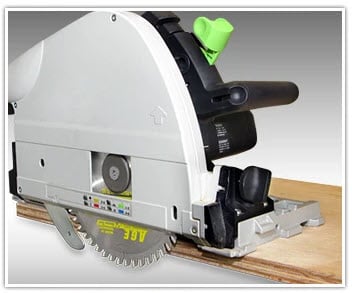 AGE Series MD160-480 For Festool Track Saw Machine Carbide Tipped Crosscut Saw Blade 48T ATB Carbide Tipped Saw Blades for Festool® and DeWalt® Track Saw machines. Cut melamine, laminate, solid surface, soft plastics, wood & more.
Cutting Melamine with a Track Saw
A track saw is particularly useful for cutting large melamine sheets into cabinet sides, shelves, and closet components. The guide rail helps maintain a straight cut, while the splinter guard supports the surface along the cut line.
For the best results:
- Choose a blade specifically recommended for melamine or laminated sheet goods.
- Make sure the blade diameter, arbor, kerf, and other specifications match your saw.
- Inspect the rail's splinter guard for wear or damage.
- Support the panel and offcut throughout the cut.
- Use the manufacturer's recommended blade depth and cutting speed.
ToolsToday offers track saw blades compatible with selected Festool and other track saw models, including blades intended for melamine and laminated panels. Check your exact saw model before ordering.
Tip: A worn splinter guard may no longer support the surface right beside the teeth. Replacing or properly trimming the guard can improve edge quality without changing the blade.
Cutting Melamine on a Table Saw
A conventional table saw is a good choice for repeatable cabinet and shelving cuts, particularly when paired with a dedicated melamine blade.
- Use a compatible zero-clearance insert to support the underside of the panel.
- Confirm that the blade and rip fence are properly aligned according to the saw manufacturer's instructions.
- Check that the blade is clean, sharp, securely mounted, and running true.
- Set the blade height according to the blade and saw manufacturer's guidance.
- Use appropriate infeed and outfeed support for large panels.
- Keep the blade guard and riving knife installed where required, and use push sticks or push blocks as appropriate.
For frequent melamine cutting, a dedicated double-face blade can be especially useful because it is engineered to reduce chipping on both the top and bottom surfaces.
If chipping continues despite a suitable blade and good support, excessive blade runout or alignment problems may be involved. These are advanced diagnostic issues best checked according to the saw manufacturer's procedures or by a qualified technician.
Cutting Melamine with a Sliding Table Saw or Panel Saw
Sliding table saws are common in cabinetmaking and panel-processing shops. Instead of pushing a large sheet along a stationary tabletop, the operator uses a moving carriage to guide the workpiece past the blade. This helps support large panels and produce accurate, repeatable cuts.
Many professional sliding table saws also use a smaller scoring blade ahead of the main blade. The scoring blade makes a shallow cut in the underside coating before the main blade cuts through the panel, reducing the chance of breakout.
For clean results, the scoring blade must be correctly aligned with the main blade and its cutting width must be properly matched. A misaligned scoring blade can leave visible steps or chipped edges.
Professional panel saws may use larger 12-inch, 14-inch, or metric-diameter blades with specific arbor and pinhole arrangements. Always verify compatibility with the saw and scoring system before selecting a replacement blade.
Melamine Cutting Problems: Causes and Fixes
| Problem | Likely Cause | What to Try |
|---|---|---|
| Chips on the top face | Teeth exiting through an unsupported surface; worn splinter guard | Check face orientation, use a suitable blade, and improve support at the cut line. |
| Chips on the bottom face | Insufficient support around the blade or unsuitable tooth geometry | Use a compatible zero-clearance insert or dedicated double-face blade. |
| Burn marks along the cut | Dull or dirty blade, binding, misalignment, or feeding too slowly | Clean or replace the blade, check alignment, and maintain a steady feed rate. |
| Rough or uneven edges | Blade vibration, panel movement, or worn teeth | Secure the panel, inspect the blade, and verify saw condition. |
| Chipping at the end of the cut | Offcut movement or inadequate support | Support both pieces and maintain control through the entire cut. |
| One face is clean but the other chips | Different tooth entry and exit conditions | Change face orientation or use a blade and support system designed for both faces. |
If several problems appear at once, start with the basics: blade condition, panel support, and alignment. Changing blades won't necessarily solve a problem caused by a shifting panel or a poorly maintained saw.
When Is a Dedicated Melamine Blade Worth Buying?
If you're making only one or two cuts in melamine, you may be able to get acceptable results with a sharp fine-finish blade, careful panel orientation, and good support.
But if you're building cabinets, closet systems, or multiple sets of shelves, chipped edges quickly become expensive. Every damaged panel can mean additional trimming, edge repair, wasted material, or a replacement cut.
A dedicated melamine blade becomes especially valuable when:
- Both faces of the panel will remain visible.
- You're cutting finished cabinet parts to final dimensions.
- You regularly work with melamine-faced particleboard or MDF.
- Your existing blade consistently chips the exit-side coating.
- You want repeatable results without relying on tape or other workarounds.
Choosing a Melamine Blade for Your Saw
For a 10-inch table saw: Consider a dedicated double-face Hi-ATB blade, such as the Amana Tool MB10800C 80-tooth melamine blade. Its specialized tooth geometry and heavy-duty plate are designed for clean cuts in melamine and laminate. Verify the 5/8-inch bore and all other compatibility requirements before purchasing.
For a track saw: Look for a melamine-rated blade designed for your specific machine. ToolsToday carries Festool-compatible and other track saw blades. Not every blade fits every model, even within the same brand.
For a sliding table saw or panel saw: Select a blade designed for laminated panels and compatible with your machine's diameter, arbor, pinholes, and scoring system. Larger professional blades are available in the ToolsToday melamine saw blade collection.
For a handheld circular saw: Start with a sharp, compatible blade specifically rated for fine cutting in melamine or laminated sheet goods. Match the blade to your saw's diameter, arbor, kerf requirements, and operating specifications.
Remember that even the best blade requires proper setup. A premium melamine blade used with inadequate support or an improperly aligned saw can still produce chipped edges.
Clean Melamine Cuts Start with the Right Combination
There's no single trick that guarantees perfect melamine cuts every time. The best results come from combining the right blade, a properly adjusted saw, stable panel support, and controlled cutting technique.
For occasional projects, improving your setup may be enough. For cabinetmakers and woodworkers who cut melamine regularly, a dedicated melamine blade can make cleaner edges easier to achieve and reduce wasted material.
Ready to improve your cuts? Explore ToolsToday's melamine saw blades to find options for table saws, sliding table saws, and panel-cutting applications.
```
FAQs
What is the best blade for cutting melamine without chipping?
A dedicated Hi-ATB melamine blade is an excellent choice, particularly one designed for clean cuts on both faces. Tooth geometry, sharpness, and blade stability are more important than simply choosing the highest tooth count.
Can you cut melamine with a regular circular saw?
Yes. Use a sharp fine-finish blade suitable for laminated panels, position the good face down, and support the sheet securely. A straightedge guide and splinter-reducing support can help improve the cut.
How many teeth should a saw blade have for cutting melamine?
An 80-tooth blade is a common choice for a 10-inch table saw, but the ideal tooth count varies with blade diameter and design. Choose a blade specifically rated for melamine rather than relying on tooth count alone.
Does painter's tape stop melamine from chipping?
Painter's tape may reduce minor surface breakout, but it cannot reliably prevent chipping caused by an unsuitable blade or poor support. A dedicated melamine blade and proper saw setup are more dependable solutions.
Why does my melamine chip on only one side?
Saw teeth enter and exit the two surfaces differently. The exit side is generally more vulnerable to chipping because the brittle coating may not be adequately supported. Correct panel orientation, splinter guards, scoring systems, or double-face melamine blades can help.
Do I need a scoring blade to cut melamine cleanly?
Not necessarily. Scoring blades are especially useful on professional panel saws, but a properly configured table saw with a quality double-face melamine blade can also produce clean results without a separate scoring blade.