11 Router Bits Every Woodworker Should Own
Table of Contents
Router bits shape, groove, trim, and join wood — making the router one of the most versatile tools in your shop. But with hundreds of bit styles available, it can be tough to know where to start.
This guide breaks down the most essential router bits you should own, what each one does, and when to use it. We’ll also explain key factors like shank size, flute count, and why some bits are better for CNC than handheld routing.
Choosing bits for a cabinet shop? See 11 Router Bits Every Cabinet Shop Should Own for bits used to cut sheet goods, make joinery, trim parts, and build cabinet doors.
Key Takeaways
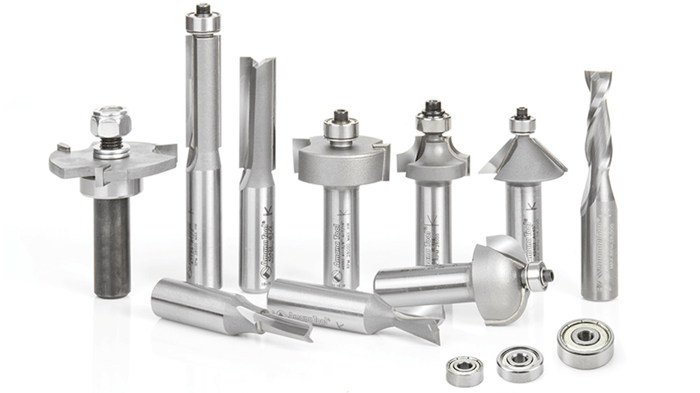
- Router bits handle different jobs: straight and spiral bits cut grooves and mortises; bearing-guided bits trim edges or cut rabbets; profile bits shape edges; and core-box and V-groove bits add decorative details.
- Choose a bit based on the cut you need, its cutting diameter and plunge capability, your router’s collet size, and whether you’re routing by hand or on a CNC.
- The guide covers 11 useful bit types, with suggested applications and a product example for each.
- A starter set offers a range of bits to try, but buying individual bits as you need them may be better value. Check that the shank sizes fit your router.
Choosing the Right Router Bit Types: What You Need to Know First
- Bit Types: Straight-Cutting vs. Edge-Forming (Profile) Bits
Straight-Cutting Bits remove material from the interior or edge of a board. These include straight, spiral, flush-trim, rabbeting, and slot-cutting bits.
Edge-Forming Bits shape the outside edges with decorative or functional profiles — like round-over, chamfer, ogee, or cove bits. - Shank Size: 1/4" vs. 1/2"
1/2" shank bits are sturdier, vibrate less, and give cleaner cuts — ideal for full-size routers.
1/4" shank bits are fine for trim routers or light-duty use. - Flute Count: 1, 2, or More?
1-flute bits are more aggressive and clear chips better in softwoods.
2-flute bits offer smoother cuts and are common in most woodworking.
3+ flutes are mostly for CNCs or specialized work where finish matters more than speed. - Plunge vs. Non-Plunge Bits
Only certain bits are designed for plunging into the material vertically (like spiral bits). Don’t try to plunge with a non-plunge bit unless you're routing in from the edge. - Cutting Diameter
This is the width of the cut the bit makes. Common sizes like 1/4" & 1/2" are useful for dadoes, grooves, and rabbets. Larger bits (like 1/2" or more) remove a lot of material quickly — so they require slower feed rates and router speeds to avoid burning or tear-out. Always adjust your settings accordingly. It is often better to remove material in multiple passes. - Handheld vs. CNC Use
Some bits are better suited to CNC use because they handle higher speeds, complex toolpaths, or produce cleaner edges under automated control. For example, spiral bits (especially compression bits) shine in CNC settings. Conversely, edge-forming bits like ogee or round-over are more often used with handheld or table-mounted routers, where the user can guide the bit along the workpiece edge manually.
11 Router Bits Every Woodworker Should Own
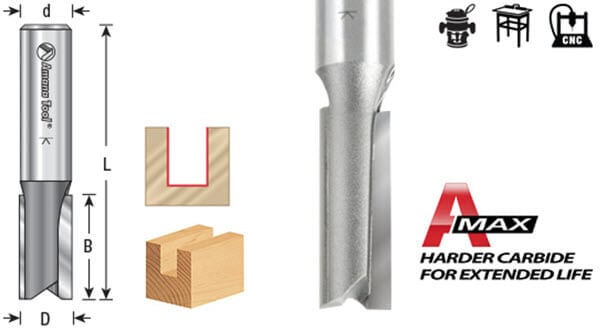
1. Straight-Plunge Bit
Great for dadoes, grooves, and mortises. Unlike edge-forming bits, this one cuts straight into the face of the wood.
- Best for: cabinetry, shelves, drawer bottoms
- Sizes to start with: 1/4", 1/2"
- Popular Item: Amana Tool 45201 Solid Carbide Cutting Edge Straight Plunge High Production 5/32" Diameter x 1/4" Shank x 7/16" Cutting Height Router Bit
Straight vs. Spiral Plunge Bits: Straight bits are cheaper and fine for basic joinery in softwoods. But spiral bits offer cleaner cuts and better chip evacuation, especially in hardwoods or plywood.

2. Spiral-Plunge Bit
These bits have a spiral cutting edge — upcut, downcut, or compression styles — for cleaner edges and less tear-out.
- Best for: mortises, grooves, and CNC routing
- Tip: Upcut = clean bottoms; Downcut = clean tops; Compression = best of both
- Popular Item: Amana Tool 46415 Solid Carbide Spiral Plunge 1/4" Diameter x 1" Cutting Height x 1/4" Shank x 1" Cutting Height 2-Flute Down-Cut Router Bit
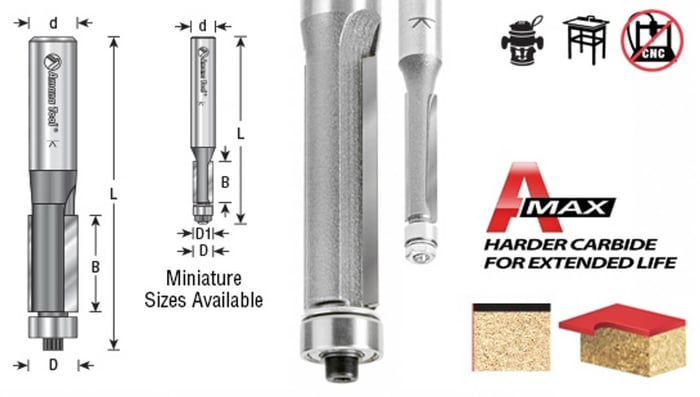
3. Flush-Trim Bit
A must-have for trimming laminates, veneers, and template work. The bearing rides along your pattern while the bit cuts flush.
- Best for: pattern routing, veneer, laminates
- Popular Item: Amana Tool 45475 Carbide Tipped Flush Trim Plunge Template 3/8" Diameter x 1/2" Cutting Height x 1/4" Shank w/ 2 Upper Ball Bearings Router Bit
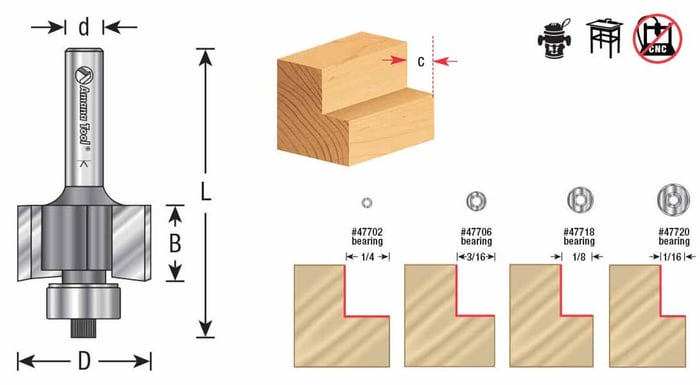
4. Rabbeting Bit
Quickly cuts L-shaped shoulders along the edge. Great for joinery, drawer backs, and cabinet construction.
- Best for: drawer boxes, cabinet backs
- Tip: Look for sets with multiple bearings to adjust the rabbet width.
- Popular Item: Amana Tool 49350 Multi-Rabbet Five Different Rabbet Depths 1-3/8" Diameter x 1/2" Shank x 1/2" Cutting Height Router Bit
Like flush-trim bits, rabbeting bits typically feature a pilot bearing.
Unlike flush bits, the cutting blade on a rabbeting bit is not "flush" with the bearing, but instead cuts deeper than the pilot. The bigger the difference, the deeper your rabbet will be.
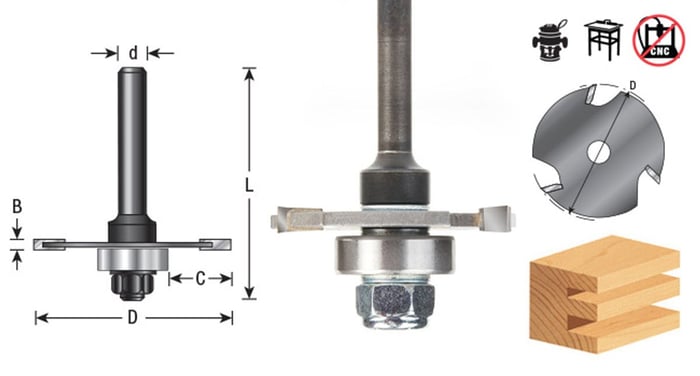
5. Slot-Cutting Bit
Cuts thin grooves into edges for splines, biscuits, or T-moldings. Ideal for cabinetry and flooring.
- Best for: spline joints, edge slots
- Tip: Some models offer interchangeable bearings to vary slot depth.
- Popular Item: Amana Tool 53406 Slotting Cutter Assembly 3 Wing x 1-7/8" Diameter x 1/4" Shank x 1/8" Cutting Height Router Bit
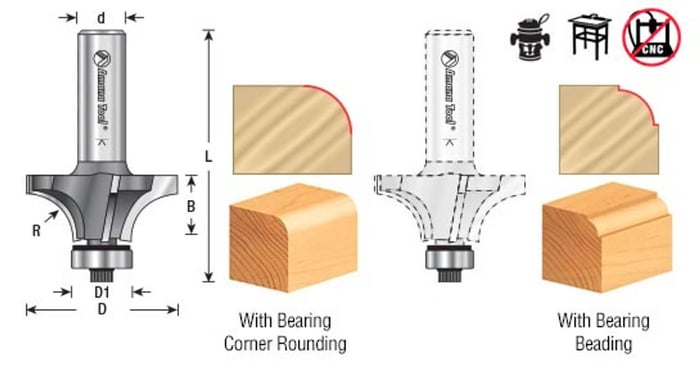
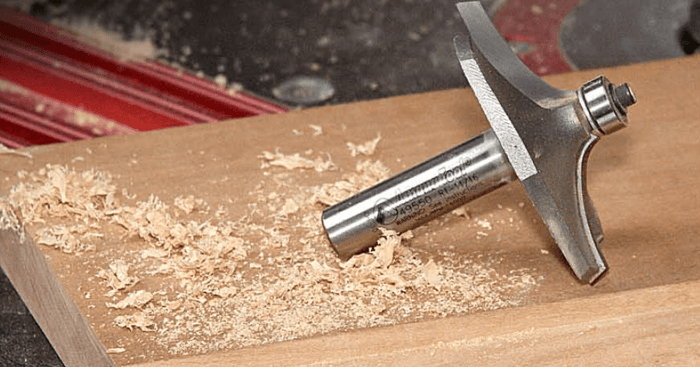
6. Round-Over Bit
Softens square edges for a finished, professional look. The radius determines how much curve you get.
- Best for: tabletops, shelves, frames
- Start with: 1/4" and 3/8" radius sizes
- Popular Item: Amana Tool 49496 Carbide Tipped Corner Rounding 1/8" Radius x 3/4" Diameter x 3/8" Cutting Height x 1/4" Shank w/ Lower Ball Bearing Router Bit
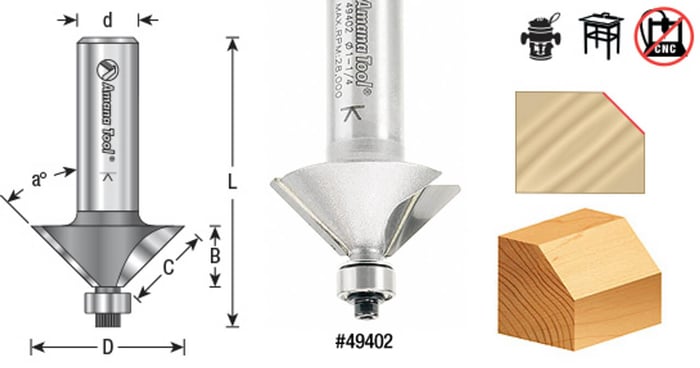
7. 45° Chamfer Bit
Cuts clean beveled edges. Chamfers are decorative but also help ease edges on sharp corners.
- Best for: picture frames, shelves, accent edges
- Tip: Can also be used to create V-grooves by joining two chamfered boards.
- Popular Item: Amana Tool 49400 Carbide Tipped Chamfer 45 Degree x 1-1/4" Diameter x 1/2" Cutting Height x 1/4" Shank w/ Lower Ball Bearing Router Bit
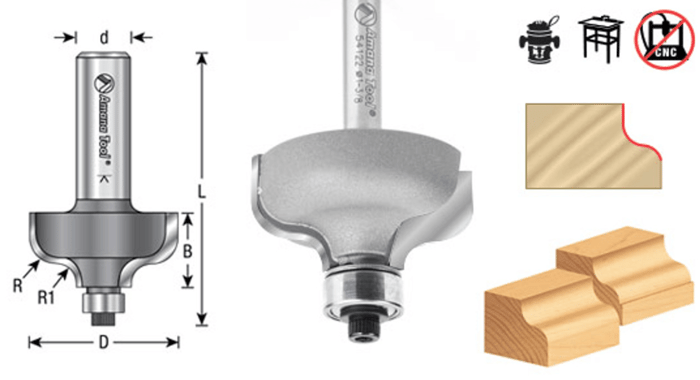
8. Roman Ogee Bit
Classic profile for decorative edge work. Ideal for traditional-style furniture or cabinetry.
- Best for: picture frames, cabinet doors, table edges
- Most common: 1/4" radius
- Popular Item: Amana Tool 49207 Carbide Tipped Roman Ogee 3/8" Radius x 2" Diameter x 1" Cutting Height x 1/2" Shank w/ Lower Ball Bearing Router Bit
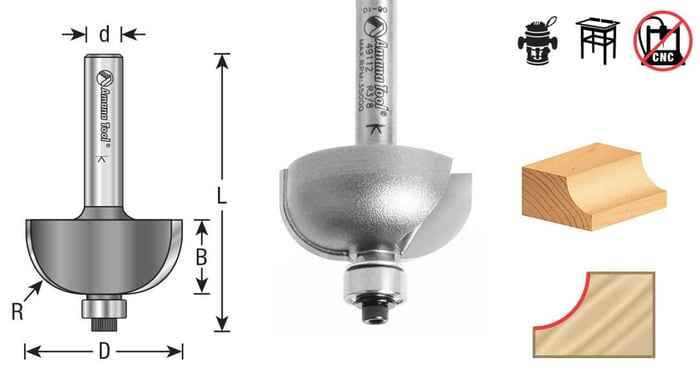
9. Cove Bit
The opposite of a round-over bit — instead of curving out, it curves in. Adds elegant detail to molding and edges.
- Best for: decorative edges, furniture legs
- Start with: 1/4" or 3/8" radius
- Popular Item: Amana Tool 49118 Carbide Tipped Cove 1/2" Radius x 1-3/8" Diameter x 3/4" Cutting Height x 1/2" Shank w/ Lower Ball Bearing Router Bit
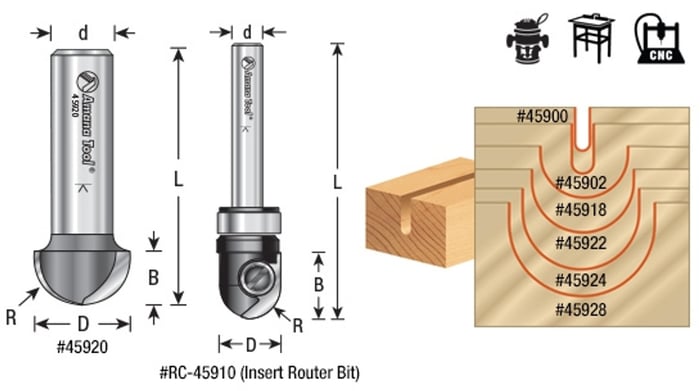
10. Core-Box Bit
This is a plunge bit. Creates round-bottomed grooves — perfect for flutes, engraving, or shallow carving.
They’re also perfect for juice grooves, or drip grooves - those shallow channels routed near the edge of a cutting board to catch juices from meat, fruit, or other juicy foods, so the liquid doesn’t spill off the board and make a mess on the counter.
- Best for: columns, panels, wooden signs
- Versatile sizes: 1/4" and 3/8" diameters
- Popular Item: Amana Tool 45926 Carbide Tipped Core Box 1/2" Radius x 1" Diameter x 11/16" Cutting Height x 1/2" Shank Router Bit
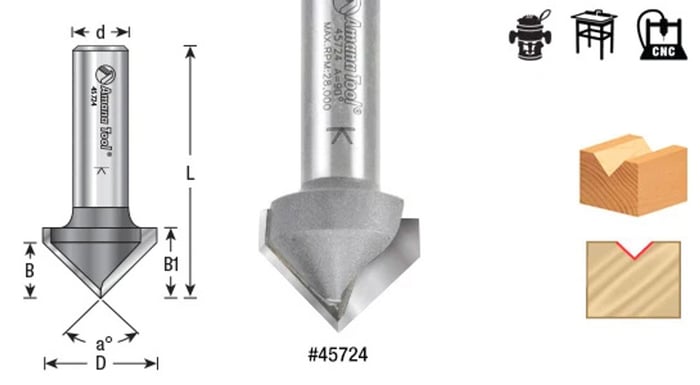
11. V-Groove Bit
I guess you can call it a plunge bit? It's definitely not a profile bit. It's really the start of a whole new category of carving & engraving bits. But that's a discussion for another day.
Cuts V-shaped decorative grooves or lettering. A go-to for sign makers and panel detailing.
- Best for: signmaking, decorative grooves
- Start with: 90° cutting angle
- Popular Item: Amana Tool 45704 Carbide Tipped V Groove 90 Degree x 1/2" Diameter x 1/4" Cutting Height x 1/4" Shank Router Bit
Should You Buy a Router Bit Set?
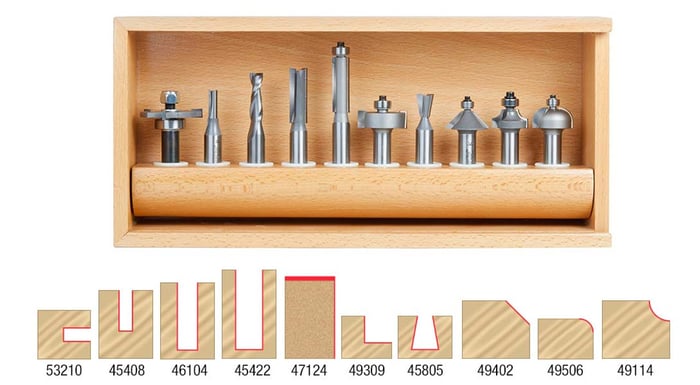
Starter sets are great if you’re just getting into woodworking and want to experiment with multiple cuts. Look for:
- Carbide tips – longer-lasting and cleaner cutting than HSS
- 1/2" shank – more stable and durable
- Well-labeled case – to help you actually find the bit you need
- Popular Set: Amana Tool AMS-410 10-Pc Woodworkers Must Have Router Bit Set
1/2" Shank Router Bit Set - For handheld routers accepting 1/4" bits only, you can't go wrong with the Timberline TRS-120 12-Piece Carbide Tipped Router Bit Set 1/4 Inch Shank.
1/4" Shank Router Bit Set - No set is perfect. The AMS-410 contains:
- Amana Tool 53210 Slotting Cutter 3 Wing x 1-7/8" Diameter x 1/4" Cutting Height x 5/16" Inner Diameter
- Includes Amana Tool 47605 Router Arbor with Hex Nuts, Washers and Ball Bearing, and 3 ball bearing guides (1/2", 5/8", & 3/4")
- Amana Tool 45408 Solid Carbide Cutting Edge Straight Plunge High Production 1/4" Diameter x 3/4" Cutting Height x 2-1/2" Long 1/2" Shank Router Bit
- Amana Tool 46104 Solid Carbide Spiral Plunge 3/8" Diameter x 1-1/4" Cutting Height x 1/2" Shank x 3" Long 2 Flute Up-Cut Router Bit
- Amana Tool 45422 Carbide Tipped Straight Plunge High Production 1/2" Diameter x 1-1/2" Cutting Height x 1/2" Shank x 3-1/8" Long Router Bit
- Amana Tool 47124 Carbide Tipped Flush Trim 1/2" Diameter x 1-1/2" Cutting Height x 1/2" Shank x 3-7/8" Long Router Bit w/ Lower Ball Bearing
- Amana Tool 49309 Rabbeting 1/2" Depth x 1-3/8" Diameter x 1/2" Cutting Height x 1/2" Shank Router Bit
- Amana Tool 45805 Carbide Tipped Dovetail 10 Degree x 1/2" Diameter x 5/8" Cutting Height x 1/2" Shank Router Bit
- Amana Tool 49402 Carbide Tipped Chamfer 45 Degree x 1-1/4" Diameter x 1/2" Cutting Height x 1/2" Shank w/ Lower Ball Bearing Router Bit
- Amana Tool 49506 Carbide Tipped Corner Rounding 1/4" R x 1" Inch Diameter x 1/2" Cutting Height x 1/2" Shank w/ Lower Ball Bearing Router Bit
- Amana Tool 49114 Carbide Tipped Cove 3/8" Radius x 1-1/8" Diameter x 9/16" Cutting Height x 1/2 Shank w/ Lower Ball Bearing Router Bit
- Amana Tool 53210 Slotting Cutter 3 Wing x 1-7/8" Diameter x 1/4" Cutting Height x 5/16" Inner Diameter
So 2 straight-plunge; 1 spiral; no v-groove bit; and instead of an ogee, you get a dovetail bit.
Which is a really cool bit, dovetails are awesome -- but "12 Router Bits Everyone Should Own" just doesn't have the same ring. :)
Final Tips
- Use the right speed. Larger bits need slower RPMs to avoid burning.
- Secure your material. Especially with aggressive plunge cuts.
- Let the bit do the work. Don’t force the cut — that’s how you burn wood and dull bits.
Explore Pro-Quality Router Bits
We carry top-of-the-line carbide router bits from Amana Tool — trusted by woodworkers and signmakers worldwide. Whether you're working by hand or on a CNC, you'll find the right bit for the job.
Updated February 2026
FAQs
What are the most essential router bits for general woodworking?
The foundational bits every woodworker should own include straight-plunge, round-over, flush-trim, rabbeting, and slot-cutting bits. These cover a wide range of basic joinery, edge profiling, and template routing tasks .
What’s the difference between straight-plunge and spiral-plunge router bits? When should I use each?
Straight-plunge bits are cost-effective and great for general cuts like grooves and mortises. Spiral-plunge bits (upcut, downcut, or compression) offer cleaner edges and better chip removal—excellent for hardwood, plywood, or CNC work.
How do I choose between a 1/4″ and 1/2″ shank router bit?
A 1/2″ shank is sturdier, vibrates less, and delivers cleaner cuts—ideal for larger handheld routers. A 1/4″ shank is sufficient for trim routers or light-duty applications.
Which router bit is best for decorative edge profiles like ogee or cove?
Roman ogee bits create classic ornate furniture edges; cove bits carve inward curves for elegant molding details. Round-over bits soften edges with smooth curves—choose based on the desired aesthetic.
What’s the purpose of a flush-trim bit?
Flush-trim bits, with a guide bearing, are essential for trimming laminates, veneers, or following templates—ensuring perfectly flush edges.
Why and when should I use a rabbeting or slot-cutting bit?
Rabbeting bits quickly cut L-shaped shoulders along edges for joinery in drawers or cabinets. Slot-cutting bits are ideal for creating grooves for splines, biscuits, or T-molding—especially useful in cabinetry and flooring.
Can I plunge with any router bit?
No—only plunge / plungeable bits (like spiral-plunge types) are designed for vertical plunging. Non-plunge bits shouldn’t be plunged unless routing from an edge, as misuse can damage the bit or material (or both).
Should I buy a router bit set or individual bits?
While sets can offer savings and convenience, many woodworkers recommend buying individual high-quality bits as needed to avoid paying for bits you may never use.
Which router bits are best for CNC versus handheld use?
CNC routing benefits from spiral bits (especially compression) for chip control at high speeds. Handheld or table routing typically uses edge-forming bits like ogee or round-over, where manual guidance is key.
How do flute counts affect router bit performance?
Single-flute bits are more aggressive and better at clearing chips—great for softwoods. Two-flute bits offer smoother cuts and are widely used. Three or more flutes are designed for CNC or tasks where edge finish is the priority.